Fence Guide
Choosing a Fence for a Household With a Dog
How to specify a fence that contains the dog you actually own — height matched to jumping ability, gaps closed at the ground line, picket spacing, sightlines, and gate hardware that latches every time.
Last updated
There is no such thing as a dog fence as a product. There is a fence, and there is a dog, and the only question that matters is whether the specification of the first accounts for the behaviour of the second. A six-foot board fence that contains a beagle for a decade will not hold a determined husky, and a fence that stops a jumper can be completely irrelevant to a digger.
This is a guide to specifying the fence rather than a pitch for a product line. We install physical fence — wood, vinyl, aluminum, chain link, picket and split rail — and the features that decide whether a dog stays in the yard are configuration choices inside those systems, not a separate category of fence. What follows is what we would want to know before quoting a fence for a household with a dog, roughly in the order it matters.
Height, and what your dog can actually clear
Height is the first number and the one most often set by habit rather than by the animal in question. Four feet holds a great many dogs and is what a lot of front yards are limited to anyway. Six feet holds most of the rest. The dogs that genuinely need more than six feet are a real but small group, and their owners usually already know it.
Athletic, high-drive breeds are what surprise people. Huskies, malamutes, German shepherds, Belgian malinois, border collies, standard poodles and most of the working and herding group will clear four feet from a standing start and can take six with a run-up when the motivation is there. Sighthounds jump well and chase harder. At the other end, a corgi or a bulldog is not going over anything, and the fence for that dog is being specified for gaps and for diggability instead.
Two things raise the effective jump beyond breed. First, anything within a few feet of the fence line that works as a launch pad: a woodpile, an air conditioning condenser, a raised bed, a retaining wall, a February snow drift. Second, horizontal rails on the dog's side of the fence, which a capable dog uses as ladder rungs in exactly the way a child does on a pool barrier. If the dog climbs rather than jumps, the rails belong on the outside face.
Digging, and what actually stops it at the ground line
Most escapes we get called about are not over the fence. They are under it — at a low spot in the grade, at a gate, or where the run crosses a drainage swale. A fence line that looks tight when you are standing next to it can have four inches of daylight beneath it once the ground settles or a heavy rain scours the soil out from the base.
Grading comes first. On rolling Chester County ground a rackable panel that follows grade continuously leaves far less gap than a stepped installation, which by definition opens a triangle of space at every step-down. Where a run has to be stepped, those triangles are the places that need closing.
The physical stoppers, in increasing order of effort: a pressure-treated kickboard along the bottom of a wood fence, which closes the gap and keeps the pickets out of ground contact at the same time; galvanised welded wire buried eight to twelve inches and turned outward at the bottom into an L; or an apron of wire laid flat on the ground, extending outward from the fence line and pinned down, which grass grows through within a season. The apron is the one that beats a committed digger, because a dog digs at the base of a barrier rather than two feet away from it, and it is far less excavation than a trench.
The other half of the answer is not structural. Dogs dig at fence lines out of boredom, out of prey drive at something moving on the other side, and to lie in cool soil in August. A dog that spends eight hours a day alone at the fence will eventually find the weak point in it.
Picket spacing and the puppy-picket configuration
Standard picket spacing on ornamental aluminum and on spaced wood picket is set by appearance and, on pool barriers, by code — not by dog containment. On a typical aluminum panel the clear gap between pickets is wide enough for a small dog or a puppy to walk straight through without breaking stride, and owners routinely discover this on day one.
The fix on aluminum is a puppy-picket panel. The lower section of the panel is manufactured with additional pickets, roughly halving the clear opening near the ground while the upper section keeps the standard ornamental spacing and the fence keeps its look from the street. It is a factory configuration rather than a field modification, and it is one of the most frequent changes we install on aluminum fence.
On wood picket the same logic applies, except the decision happens at the design stage. A spaced picket fence can be built to any gap you specify, and the difference between a three-inch and a one-and-a-half-inch opening is a line on the order rather than a retrofit. Deciding it once, before material is ordered, is dramatically cheaper than adding anything later.
Split rail, post-and-rail and the case for mesh backing
Split rail and post-and-rail are the boundary fence Chester County horse country is built on, and on their own they are the wrong fence for a dog. A three-rail fence has two large open bays, and any dog that can get its shoulders through one is through. They also present a very good ladder to a climber.
The standard answer is to back the rail fence with wire. Welded wire or woven no-climb mesh fastened to the animal side of the rails keeps the rail fence appearance from the road while closing the bays, and it can be run down to grade and turned outward at the bottom in the same operation. Black or dark-green vinyl-coated mesh visually disappears at any distance, which is why it is the usual choice on frontage where the look matters.
The principle generalises to any fence with a horizontal-only structure. The rails give the fence its character; the mesh does the containment. Decide which face the mesh goes on with both the dog and the neighbour in mind, because the mesh belongs on the dog's side while the finished rail face conventionally belongs to the neighbour.
Sightlines, barking and reactivity
This gets left out of nearly every fence conversation, and it changes how the yard feels to live in more than any other decision on this page.
A dog that can see the sidewalk will react to the sidewalk. An open picket or ornamental fence gives a reactive dog a continuous supply of triggers — walkers, other dogs, delivery vans, cyclists — and rewards every bark with the trigger walking away, which is precisely the reinforcement schedule that builds a barrier-reactive dog. Fence-line running and fence fighting with a neighbour dog through an open fence is the same mechanism at closer range.
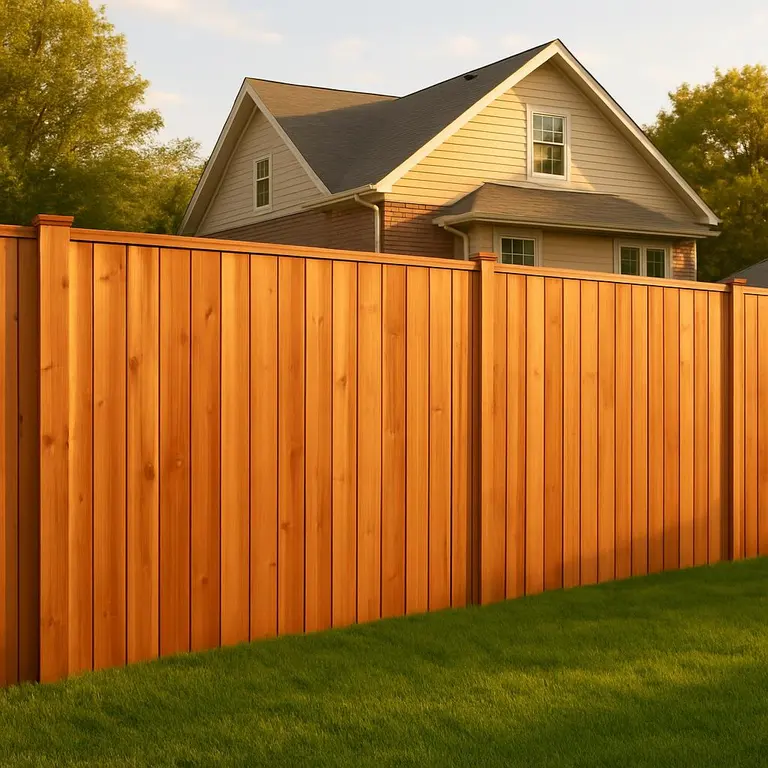
A solid privacy fence removes the visual trigger. For a reactive or barky dog it is frequently the single most effective change available, more than height and more than any hardware. The trade-off is that it removes your view as well, it can make a small yard feel smaller, and it does nothing for a dog that reacts to sound alone.
The reverse is also true and worth saying plainly. Some dogs are settled by being able to watch the street and do worse behind a solid wall, and plenty of households genuinely want the open sightline for themselves. There is no universal answer here — only a decision that ought to be made deliberately rather than by default.
Gates are where containment actually fails
Almost every escape that is not a dig is a gate. The gate was left open by a lawn crew, a delivery driver, a visiting child, or by the owner carrying something with both hands. The fence performed perfectly and the dog is two streets away.
Self-closing hinges are the cheapest insurance on the property. A spring or tension hinge that pulls the gate shut from any open position removes the human step entirely, and gravity hinges do the same thing with no spring to weaken over time. Pair it with a self-latching latch so that closing and securing are one motion, and the gate looks after itself whether or not anyone was paying attention.
Add a second layer for a dog that works latches, and some genuinely do: a drop rod into a ground sleeve, a slide bolt, or a keyed or combination latch. Mount the hardware so it is reached over the top of the gate rather than through the fence. And check the swing seasonally, because a gate that drags on the ground at one point in its arc will not self-close, which is the same outcome as never having fitted the hinge.
Invisible and underground systems, honestly
Electronic containment comes up in every one of these conversations, so it is worth being direct about it. We install physical fence and not underground or wireless systems, which means there is no product here for us to defend in either direction.
They work for some dogs. A biddable, moderate-drive dog trained to the boundary flags properly over several weeks will respect the line, the system costs less than a fence, and it preserves an open view on a property where an ordinance or an HOA covenant would not permit a physical barrier anyway.
The limitations are structural rather than fixable. The boundary only exists for the dog wearing the collar, so nothing keeps other dogs, wildlife or people out of the yard, which is not a small point in a county with this much deer and coyote activity. A dog in full prey drive takes the correction and keeps going, and once it is outside the line the same barrier now sits between it and coming home. Batteries die and receivers fail quietly, and you find out when the dog is gone. The correction is aversive, and on an anxious or already reactive dog it can attach that discomfort to whatever the dog was looking at — the passing jogger, the dog across the street — which is a training problem the household did not have before.
The honest summary is that an electronic boundary is a training aid whose reliability depends on temperament and on ongoing maintenance, while a physical fence is a barrier that depends on neither. Households that want certainty build the fence. Where an invisible system is the only thing the ordinance or the HOA will allow, it beats nothing, and it should be chosen with its failure modes understood rather than assumed away.
Common questions
Frequently Asked Questions
How tall should a fence be to keep a dog in the yard?
Four feet contains a great many dogs and six feet holds most of the rest. Athletic working and herding breeds — huskies, shepherds, malinois, border collies and most sighthounds — can clear four feet from a standing start and take six with a run-up. Just as important is what sits near the fence line, because a woodpile, condenser unit or retaining wall within a few feet of the fence effectively lowers it, and horizontal rails on the dog's side work as climbing rungs.
What is the best way to stop a dog digging under a fence?
Close the ground line rather than raising the fence. A pressure-treated kickboard along the bottom of a wood fence seals the gap and keeps the pickets out of soil contact. For a determined digger, galvanised welded wire buried eight to twelve inches and turned outward into an L, or an apron of wire laid flat on the ground and pinned down, both work — the apron usually better, because a dog digs at the base of the barrier rather than a couple of feet out from it, and it takes far less excavation.
Will an aluminum fence keep a small dog in the yard?
Not in the standard configuration. Ornamental picket spacing is set by appearance and by pool-barrier code, and the clear gap is wide enough for a small dog or a puppy to pass straight through. The answer is a puppy-picket panel, where the lower section is manufactured with extra pickets that roughly halve the opening near the ground while the upper section keeps normal spacing and the fence keeps its look. It is a factory option, and it is one of the most common modifications we install.
Does a privacy fence stop a dog from barking?
Often, and more effectively than any other single change. A dog that can see the sidewalk reacts to the sidewalk, and every bark is rewarded by the walker or the other dog moving away, which is the exact pattern that builds barrier reactivity. A solid fence removes the visual trigger entirely. It will not help a dog that reacts to sound alone, and it costs you the view as well, so it is a trade rather than a free win.
Is a split rail fence good for dogs?
Not by itself. A two- or three-rail fence leaves large open bays that most dogs simply step through, and the rails make an excellent ladder for a climber. Backed with welded wire or woven no-climb mesh on the animal side, it becomes a genuine containment fence while keeping the rail-fence appearance from the road. Black or dark-green vinyl-coated mesh disappears visually at any distance, which is why it is the standard choice on frontage.
Is an invisible fence as good as a physical fence?
For containment, no, though it suits some dogs. We install physical fence rather than electronic systems, so this is not a product opinion. An electronic boundary only exists for the dog wearing a working collar, so it keeps nothing out of the yard, a dog in prey drive will take the correction and leave, and the same line then stands between it and home. Batteries and receivers fail silently. Where an HOA or ordinance forbids a physical barrier it is a reasonable option, understood for what it is.