
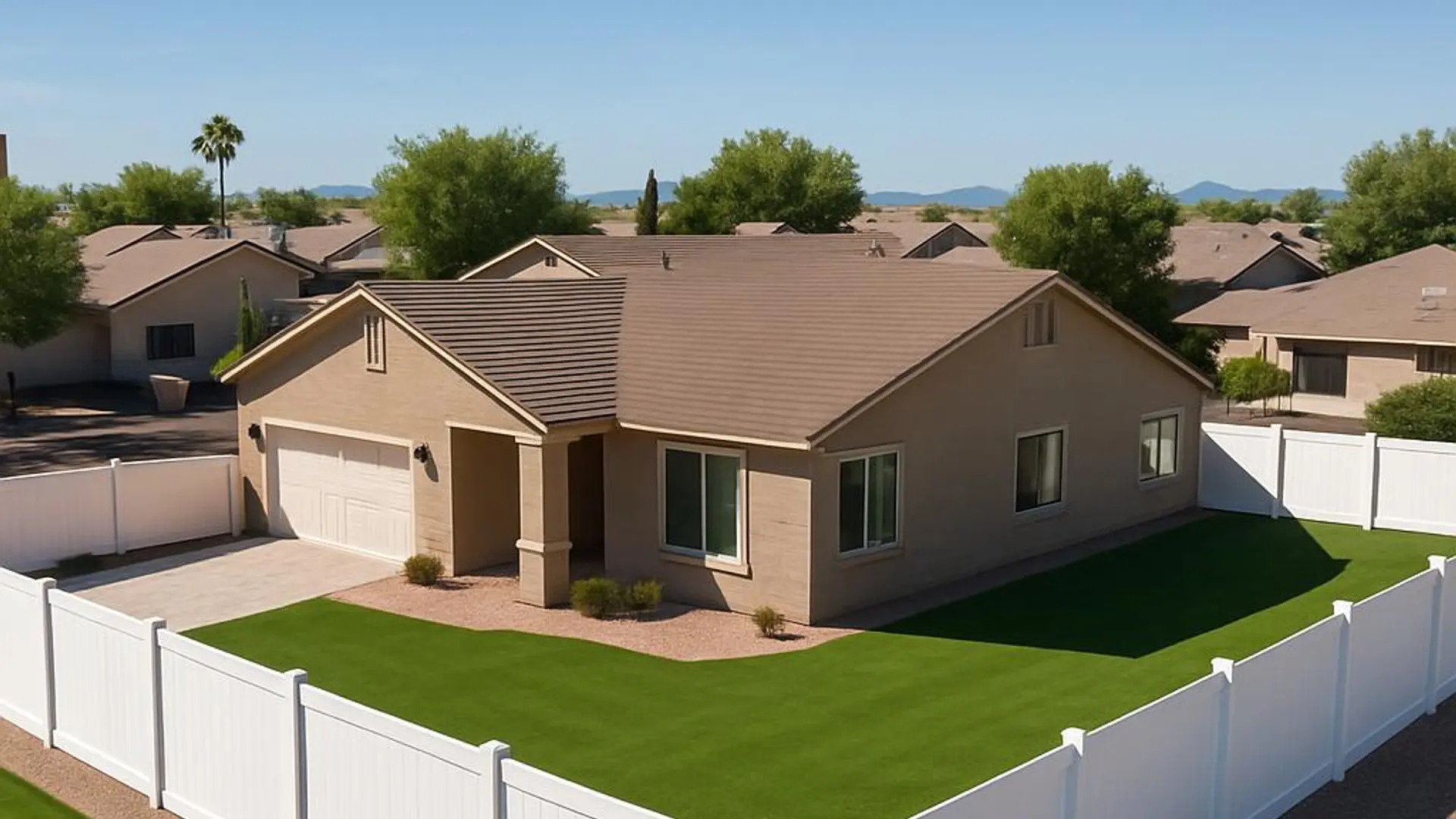
Fence & gate services
Pool Fence Installation
A pool barrier is the one fence on your property that has a code section written specifically about it. We build to pass inspection the first time.
Licensed & Insured
PA Home Improvement Contractor #PA035784
Free Written Estimates
On-site assessment included
Permits & HOA Handled
We file on your behalf
Workmanship Guarantee
On every installation
Pool Fences in Chester & Delaware County
Pennsylvania regulates pool enclosures under the adopted building code, and the requirements are specific: minimum barrier height, maximum gap beneath the barrier, picket spacing narrow enough to reject a defined gauge, no external climbable horizontal members within the barrier height, and gates that are self-closing and self-latching with the latch at a required height and orientation.
The requirement that catches people most often is the climbable-member rule. A standard privacy or picket fence with horizontal rails on the outside face gives a child a ladder, and it will fail inspection even if the height is right. That is why powder-coated aluminum in a flat-top configuration is the default pool barrier here — the rails sit inside the picket line and there is nothing to climb.
The second most common failure is gate hardware. A gate that latches but does not self-close, or a latch mounted below the required height on the outside of the gate, is a fail. We install code hardware as part of the barrier rather than as an accessory.
Because townships adopt and enforce code on their own schedule, we confirm the applicable requirement with your specific municipality before ordering material. That confirmation is part of the job, not an extra.
Options
Styles & Configurations
Flat-top aluminum
The standard code-compliant barrier. No climbable outer rails, no protruding finials, self-closing gate hardware.
Vinyl privacy barrier
Where the pool enclosure doubles as the privacy screen. Requires careful rail placement to satisfy the climbable-member rule.
Removable mesh
Tensioned mesh in removable posts, used where the barrier must come down seasonally. Suits some in-ground installations, subject to township acceptance.
What to expect
How the Installation Runs
- Site walk and barrier layout, including gate positions relative to the house and pool equipment.
- Confirmation of the current pool barrier requirement with your township before material is ordered.
- PA One Call utility mark-out.
- Permit application filed.
- Post setting, panel installation, and code gate hardware — self-closing hinges, self-latching hardware at the required height.
- Pre-inspection walk-through: we verify height, gaps, spacing, latch height and gate swing before the inspector arrives.
Where we install it
Pool Fences By Town
Common questions
Pool Fences Questions
What are the pool fence requirements in Pennsylvania?
Pennsylvania enforces pool barrier requirements through the adopted building code at the municipal level. In substance they cover minimum barrier height, the maximum gap between the barrier and the ground, picket spacing, the absence of climbable horizontal members on the outside face, and self-closing, self-latching gate hardware with the latch at a specified height. Because townships adopt and enforce on their own schedule, we confirm the exact figures with your municipality before ordering.
Can a privacy fence be used as a pool barrier?
Sometimes, but not automatically. A solid privacy fence can satisfy the height and gap requirements, but if its horizontal rails are on the outside face they create climbable members and it will fail. Rail placement, gate hardware and the gap at grade all have to be handled deliberately. We assess this before quoting rather than after inspection.
Does a pool fence gate have to self-close?
Yes. Gates in a pool barrier must be self-closing and self-latching, with the latch positioned at the required height and, where the latch is below that height, mounted on the pool side with the surrounding area shielded. A gate that latches only when someone pushes it closed is a failed inspection.
Why is aluminum the usual choice for a pool fence?
Because it satisfies the code cleanly. Flat-top aluminum has no protruding finials, its rails sit within the picket line so there is nothing climbable on the outside face, picket spacing is manufactured to the required gap, and code gate hardware is a standard option. It also does not rust in a chlorinated, wet environment.
Do I need a permit for a pool fence?
Yes. Pool barriers are permitted and inspected in every municipality in our territory. We file the application and prepare for inspection as part of the installation.
How far from the pool does the fence have to be?
That is set by your municipality and, for above-ground pools, can also depend on whether the pool wall itself forms part of the barrier. Setback from the water, from property lines and from structures all interact. We confirm the applicable distances with your township during the assessment.
Get a free pool fences estimate
On-site assessment. Written quote. No obligation.