
Reference
Fence Glossary
The words that turn up on an estimate, a permit application or an HOA submission — defined the way the trade actually uses them.
Styles
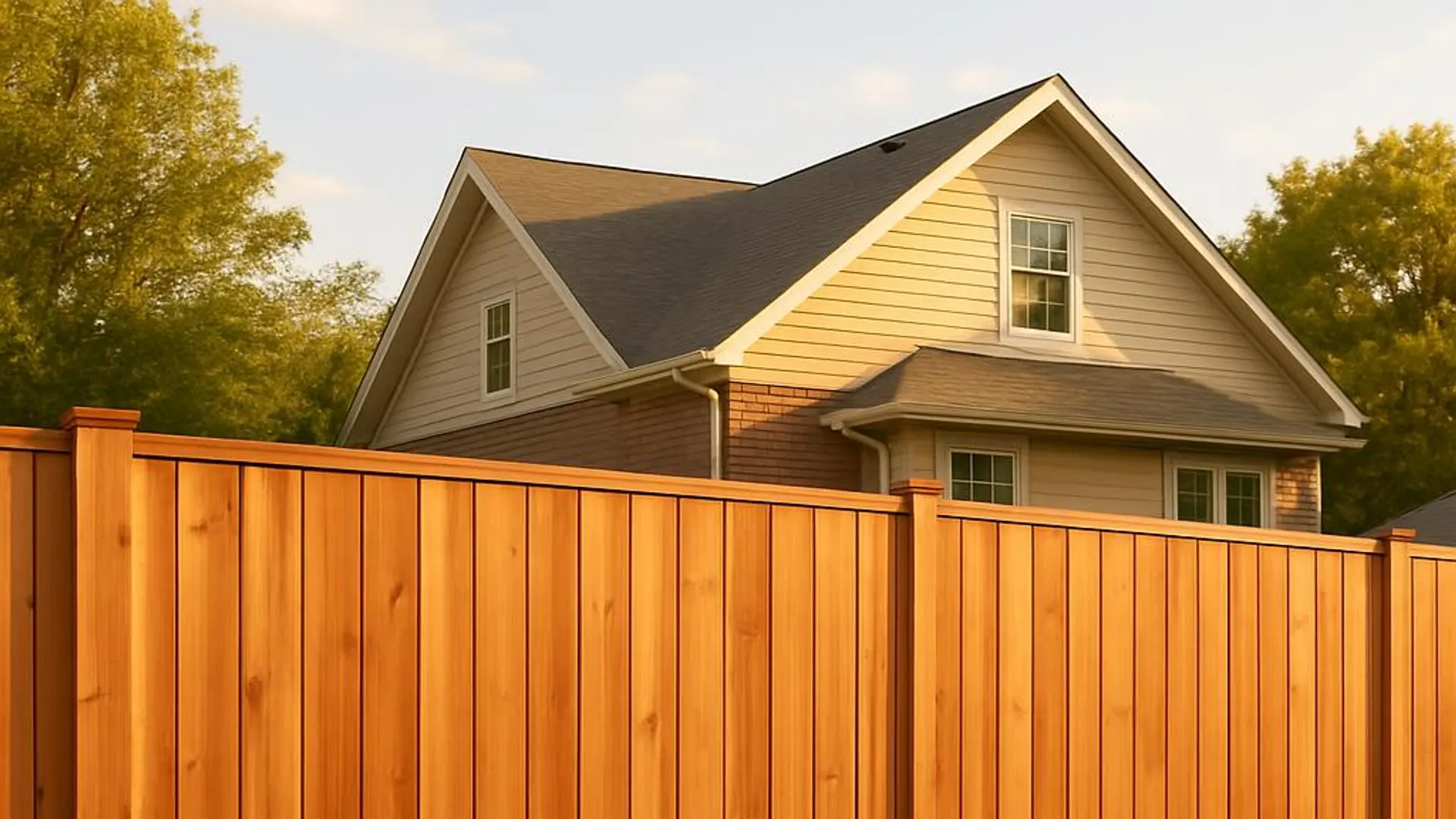
- Board-on-board
- A wood privacy fence style in which vertical boards are mounted on the same face of the rails and overlapped edge to edge, so no gap exists at any viewing angle. The overlap absorbs the seasonal shrinkage that opens daylight in a butted fence.
- Shadowbox
- A privacy fence style in which boards alternate from one side of the rails to the other, overlapping when the fence is viewed straight on. It screens a yard while letting wind pass through, and because boards appear on both faces it satisfies the good-neighbour standard many HOAs require.
- Stockade
- A wood privacy fence built with pickets butted edge to edge against one face of the rails, usually with dog-ear or pointed tops. It is the least expensive way to close a sightline completely, and the style most likely to open gaps as the boards dry and shrink.
Structure
- Rail
- The horizontal member that spans between posts and carries the pickets, boards or mesh of a fence. Rail count and dimension decide how much load a section holds without sagging; in post-and-rail and split rail fencing the rails are the fence itself rather than its frame.
- Picket
- An individual vertical member fastened to the rails of a fence. Picket width, spacing and top profile decide how the fence reads from the street and whether it satisfies a code requirement — spacing narrow enough to reject the specified gauge is what separates a pool barrier from an ordinary yard fence.
- Post cap
- The finished top fitted to a fence post — flat, pyramid, ball, gothic or lit. Beyond appearance it is a water-management component: the cap sheds rain off the exposed end grain of a wood post, which is the point where rot and freeze damage almost always begin.
- Tension wire
- A heavy-gauge, usually coiled-spring steel wire run along the bottom — and sometimes the top — of a chain link fence and tied to the fabric, holding the mesh against the ground line. It is what stops the bottom of a chain link fence being pushed up or pulled away from the posts.
- Terminal post
- Any post that ends a run of fence — an end post, a corner post or a gate post. Terminal posts carry the pull of tensioned fabric or the weight of a gate, so they are larger in diameter, set deeper and footed heavier than the line posts between them.
- Line post
- The intermediate posts between terminals, carrying the fence along the length of a run. A line post supports the fabric or panel and resists wind load, but it is not asked to hold tension, so it is lighter than a terminal post and spaced at a regular interval down the line.
Installation
- Frost line
- The maximum depth to which ground can be expected to freeze at a given location. Fence post footings are set below it so that water freezing in the surrounding soil cannot lift the post. In southeastern Pennsylvania the depth enforced is set by the municipality, not statewide.
- Footing
- The concrete or compacted base a fence post is set into. Its depth, diameter and drainage decide whether the fence holds its line, because a fence footing resists wind load and gate weight trying to rotate the post — not just the dead weight of the panels above it.
- Racking
- Adjusting a fence section so its rails follow the slope of the ground while the pickets stay vertical, producing a continuous top line with no gap underneath. Rackable systems pivot at the picket-to-rail connection, and how much drop a panel can absorb is a limit set by the product.
- Stepping
- Installing fence sections level and dropping each one at the post to follow falling ground, so the fence descends a slope in stairsteps. It is the alternative to racking, and it is what steep grades and rigid panel systems require — at the cost of a gap beneath each section.
- Gate hardware
- The hinges, latch, drop rod, stops and closers that make a gate work — the part of a fence that moves, and therefore the part that fails first. Hardware is specified to the weight and swing of the gate rather than to the fence, and on a pool barrier it is a code component.
- PA One Call
- Pennsylvania's statutory one-call utility notification system. Anyone planning to excavate — including digging post holes for a fence — notifies the system, which relays the request to the facility owners in the area so they can mark their buried lines before work starts. The notice is a legal obligation, not a courtesy.
Code & Permits
- Setback
- The distance a municipality requires between a fence and a property line, street right-of-way, sidewalk or easement. It lives in the zoning ordinance rather than the building code, it differs between townships that share a border, and the figure binding on a given parcel comes from that municipality alone.
- Right-of-way
- The strip of land a public road occupies, together with the margin the municipality or PennDOT holds beside it for sidewalk, utilities and maintenance. It is usually wider than the paved surface, extends into what looks like private lawn, and fence setbacks are measured from its line.
- Easement
- A recorded right allowing someone other than the owner to use a defined strip of a property — typically a utility company, a municipality, or a neighbor with a shared driveway. The land stays yours, but what you may build within the easement is limited by the terms of the grant.
- Pool barrier
- The fence, wall, gate and hardware assembly that separates a swimming pool from the rest of a property, and the only fence type with a code section written specifically about it. A barrier is judged as a system: height, gap at grade, opening spacing, climbable members and gate hardware all have to pass together.
- Self-closing gate
- A gate fitted with spring hinges or a closer that returns it to the closed position on its own, from any open position, with nobody touching it. On a pool barrier this is not an upgrade — the adopted code requires the gate to close and latch by itself, and the inspector tests it.
- Self-latching latch
- A latch that engages automatically when the gate swings shut, without being lifted, pushed or turned by hand. Pool barrier code pairs it with a self-closing gate and specifies where the latch sits — high on the outside face, or lower on the pool side behind a shielded section of barrier.
Materials
- Powder coat
- A dry finish applied as electrostatically charged powder and then oven-cured, so it fuses into a continuous shell bonded to the metal rather than sitting on it as a film. It is the standard finish on aluminum and ornamental fence, and the reason those systems never need repainting.
- Galvanized
- Steel coated in zinc so the zinc corrodes first and protects the steel underneath. In fencing it describes chain link fabric, framework and fittings, and it is why a bare chain link fence in this climate greys rather than rusts through. Coating weight, not the word itself, decides how long it lasts.
- Vinyl-coated chain link
- Galvanized chain link fabric and framework sheathed in a bonded or extruded PVC layer, almost always black or dark green. The coating adds a corrosion barrier over the zinc and, more usefully, makes the fence visually recede — a dark mesh reads as far less of an object than a bright one.
Going Deeper
Permits, pool barrier code, HOA review, height limits and cost are covered at length in our fence guides, and the short answers live in the fence FAQs.
Ready for a straight fence line?
On-site assessment. Written quote. No obligation.