Fence glossary · Styles
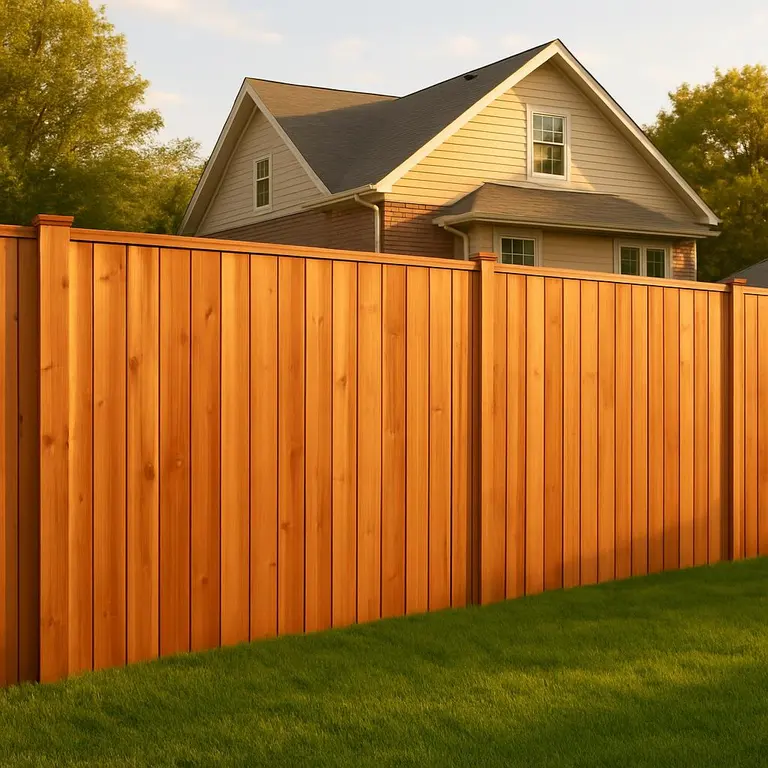
Board-on-board
A wood privacy fence style in which vertical boards are mounted on the same face of the rails and overlapped edge to edge, so no gap exists at any viewing angle. The overlap absorbs the seasonal shrinkage that opens daylight in a butted fence.
The overlap is the entire point of the style. A stockade fence butts its boards tight and is genuinely solid the day it is finished, but cedar and pressure-treated pine both keep giving up moisture after installation, and as every board narrows a fraction of an inch a line of daylight opens down the run. Board-on-board starts with roughly an inch of overlap at each joint, so the boards can move and the sightline stays closed. That is why it is the style we build when the reason for the fence is a neighbour's window or a road rather than simply a boundary.
It costs more because it uses more board — a run consumes materially more picket stock per linear foot than a butted fence of the same height — and it is heavier, which puts real load on posts and gates. That weight matters in this territory. Chester County's clay-heavy ground holds water rather than draining it, and a heavy fence on shallow posts is the textbook frost-heave failure. Board-on-board wants footings below the local frost line, three rails at six feet, and gate posts sized for the weight of the leaf they will carry.
Because the boards sit on one face of the rails, the rails run behind them on the other side, which makes the overlapped face the finished face. Which way it points is a decision worth making deliberately rather than by default: most HOA architectural standards along the Main Line and in newer Chester County developments have a view on it, and some township ordinances do too. Where a standard requires a fence that reads identically from both sides, the answers are a double-sided build with boards on both faces of the rails, or shadowbox, which achieves it by construction.