Fence Guide
Which Side of a Fence Should Face the Neighbor?
The good-side-out convention, where it is genuinely enforceable and where it is only custom, the fence styles finished on both faces, and the pool-barrier rule that reverses it.
Last updated
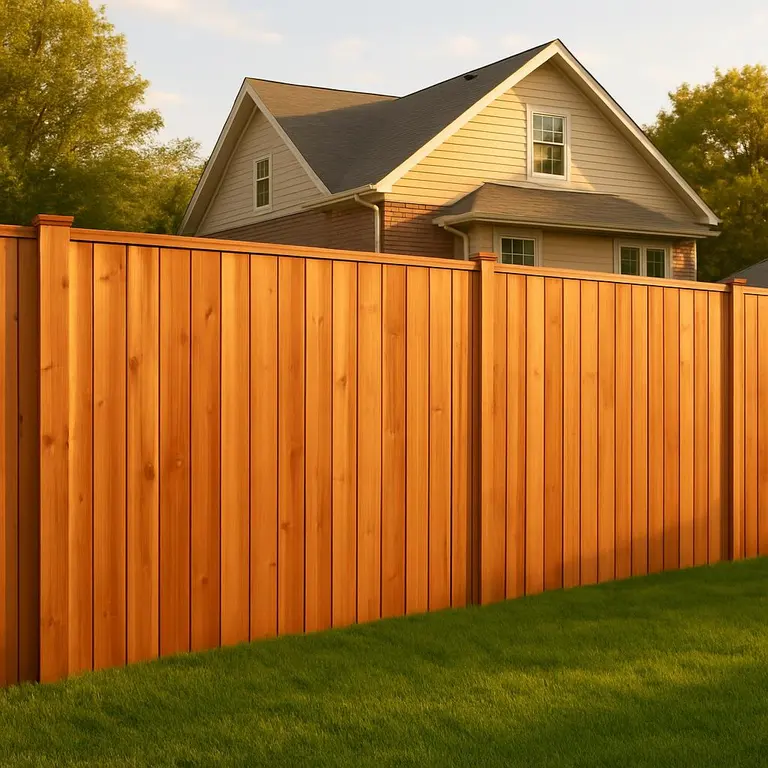
The convention is that the finished side faces out — the neighbor and the street see the smooth face, and the posts and rails stay on your side. It is old, it is widely held, and homeowners routinely assume it is law. In Pennsylvania it usually is not.
What it is instead is three separate things that get conflated: a custom with nothing behind it, a covenant with real enforcement behind it, and a building-code requirement that in one specific case demands the opposite orientation. Working out which of the three applies to your fence line is what decides the design, and it is a far easier conversation to have while the fence is still a drawing.
Where good-side-out is actually written down
No Pennsylvania statute directs which face of a residential fence points at the neighbor. The convention exists because it is sensible and because it has been repeated for a century, not because the state codified it.
Enforceable versions do exist, and they come from three places. A municipal ordinance can require it — a minority of townships and boroughs in southeastern Pennsylvania include a finished-side clause in their fence section, and where they do it becomes a permit condition. A homeowners association can require it through its architectural guidelines, which is by far the most common binding source in our territory. And a recorded deed restriction or an easement agreement can require it for one specific parcel, independent of either.
Everywhere else it is custom. Custom is not nothing — it is what the code officer expects to see, what an agent will remark on at resale, and what the neighbor believes they are owed. But if the question is whether anyone can compel you, the answer comes from the ordinance, the architectural guidelines and the deed, in roughly that order of how often it actually bites.
The HOA version, which is the one that usually governs
Across the Main Line and the newer developments through Chester and Delaware County, the requirement most likely to apply is the community's good-neighbor standard. Wording varies, substance does not: the fence must present the same appearance from both sides, or the finished side must face outward toward adjoining lots and common areas.
Read which of those two it says, because they are not the same requirement. Finished-side-out permits a fence with a structural face, provided the structural face is yours. Identical-from-both-sides does not — it rules out standard stockade and one-sided board fence entirely, whichever way you turn them, and it is the single most common reason a design has to change at architectural review.
In most communities the requirement sits in the architectural guidelines rather than in the recorded declaration, so request both documents. A rejection on this point costs a full meeting cycle, and committees meet monthly more often than not.
The styles that make the question disappear
Two wood styles solve the problem structurally instead of by choosing a side, and both satisfy an identical-from-both-sides standard without argument.
Shadowbox alternates boards on opposite faces of the rail, so each side shows a continuous run of boards with the rail visible only behind the gaps. It reads as a finished fence from both properties, it lets wind through — which matters more than homeowners expect on an exposed rear line — and it is the style architectural committees approve most readily. The trade-off is that a sharp viewing angle shows partial gaps.
Board-on-board overlaps boards on the same face of the rail with no gap at any angle, and because the overlap is generous the finished appearance carries to both faces. It is the more complete privacy of the two and the heavier fence, and the overlap absorbs the shrinkage as cedar dries, so gaps do not open in year three the way they do on stockade. Both styles build in western red cedar and both exist as vinyl systems.
On the ornamental side the question rarely arises at all. An aluminum picket panel is symmetrical, so there is no good side to argue about — only the question of which face the pickets are mounted to, which matters for a different reason.
Rails, climbability, and what the outside face invites
The horizontal rails are the actual subject of the dispute. On a conventional board fence the rails span between the posts and the boards fasten to one face of them, which leaves two or three continuous horizontals exposed on the other face.
Those horizontals are a ladder. Anything on the outside of a six-foot fence that a foot can rest on reduces it, in practical terms, to a four-foot fence. That is a consideration on a street-facing run, a real one where a rear line backs onto a public path or an alley, and a code matter around a pool. It is also the honest reason some homeowners resist good-side-out on a particular stretch.
The resolution on wood is a style with no exposed horizontals — shadowbox and board-on-board both bury the rail behind boards on each face — or, where rails must be exposed on one side, putting them on the side that is not the exposure. Aluminum sidesteps it entirely, because the rails sit inside the picket line by design and there is nothing on either face to climb.
A pool barrier reverses the rule, and the two can collide
This is the one case where the code takes a position, and the position runs against the convention on the inside face.
Pool barrier provisions in the adopted building code prohibit climbable horizontal members on the outside face of the barrier within the required height. A conventional rail-and-board fence serving as a barrier therefore has to be oriented with its rails on the pool side. Facing outward, that agrees with good-side-out. Facing inward, it means the pool owner looks at the structural side of their own fence every day.
The genuine conflict appears when the pool barrier is also the boundary fence and the community requires identical appearance from both sides. A rail-and-board fence cannot satisfy both, because one face will always carry the rail. The usual answer is to stop trying: flat-top powder-coated aluminum has no external horizontals, is symmetrical from both faces, and meets the barrier specification without the argument. It is why most of the pool enclosures we install in this territory are aluminum.
Where wood is required for aesthetic reasons, the workable version is shadowbox or board-on-board with the rail concealed on both faces, confirmed against the barrier requirement with the governing municipality before material is ordered — barrier provisions are adopted and amended locally, so the specification that applies is the one your township enforces.
Have the conversation before the posts go in
The highest-return thing a homeowner can do on a shared boundary is talk to the neighbor while the fence is still on paper. Not to ask permission — on your own land, inside your own line, you do not need it — but because nearly everything that becomes a dispute started as a surprise rather than a disagreement.
Six things are worth covering, and the whole conversation takes about ten minutes at the property line.
- Show them the line. Where the fence sits relative to the surveyed boundary is the fact most often assumed and most often wrong, particularly on older Delaware County parcels where the existing fence sits well inside the true line.
- Show them the style and the height, and say plainly which face they will be looking at.
- Say when the work happens and roughly how long a crew will be on site.
- Ask about sprinkler heads, buried pet-containment wire, low-voltage lighting runs, drainage and any planting within a few feet of the line. None of that shows up on a PA One Call mark-out, which locates public utilities, not private ones.
- Ask whether they want their face stained or sealed to match, and settle who pays for what before anyone starts.
- If either of you is considering sharing the cost, put the arrangement in writing, including who maintains it afterward, before anything is built.
When the fence is already there and the rails face you
Where a fence already runs the line and its structural side faces your yard, the first question is whose fence it is, and that is answered by where it sits relative to the surveyed boundary — not by which way it faces or who mows nearest to it.
If it is the neighbor's fence standing on the neighbor's ground, its appearance from your side is theirs to decide. Building your own fence a short distance inside your own line is legal and common, and it produces the double-fence lines seen throughout older Delaware County neighborhoods. Leave enough gap to maintain both faces, or you create a strip nobody can reach and both fences rot from the inside.
If the existing fence sits on your ground, the question stops being aesthetic and becomes a boundary matter. A current survey is the starting point, and it is worth having before any conversation rather than after one has gone badly.
Common questions
Frequently Asked Questions
Is there a law in Pennsylvania about which side of a fence faces the neighbor?
Not at state level. Pennsylvania has no statute directing which face of a residential fence points outward. Enforceable requirements come from three narrower sources: a municipal ordinance that includes a finished-side clause in its fence section, an HOA architectural guideline, or a recorded deed restriction on a specific parcel. Absent one of those, good-side-out is custom rather than law — widely expected, but not something a neighbor can compel.
Which side of a fence is the good side?
The face without the visible posts and horizontal rails. On a conventional board fence the boards fasten to one face of the rails, leaving the rails exposed on the other. The board face is the finished or good side, and the convention is to point it away from your property, toward the neighbor and the street.
What fence styles look the same from both sides?
Shadowbox and board-on-board are the two standard answers in wood. Shadowbox alternates boards on opposite faces of the rail; board-on-board overlaps boards on the same face with enough overlap that both sides read as finished. Aluminum and ornamental picket panels are symmetrical by construction, and most vinyl privacy panels are finished identically on both faces.
Can my HOA decide which way my fence faces?
Yes. A good-neighbor provision in the architectural guidelines is enforceable and is the most common binding requirement in our territory. Read the exact wording, because finished-side-out and identical-from-both-sides are different standards. The second rules out stockade and one-sided board fence no matter how they are turned, and it is the most frequent reason a submitted design has to be revised.
Which way do the rails face on a pool fence?
Toward the pool. The adopted building code prohibits climbable horizontal members on the outside face of a pool barrier within the required height, because exposed rails work as a ladder. That means a rail-and-board fence used as a barrier must be oriented with its rails inside. Flat-top aluminum avoids the problem entirely, since its rails sit within the picket line and neither face is climbable.
Do I need my neighbor's permission to build a fence on my property line?
Not to build entirely on your own ground inside the surveyed line. Building on the boundary itself is a different arrangement with shared consequences and is worth documenting. Either way, a conversation before installation costs nothing and prevents most of the disputes we see — establish where the surveyed line actually runs first, because assumed lines are wrong more often than not on older parcels.