
Fence & gate services
Composite Fence Installation
Composite fence board keeps the mass, grain and shadow line of a cedar fence and drops the part of cedar that fails — the cupping, the splintering and the stain schedule that holds it all together.
Licensed & Insured
PA Home Improvement Contractor #PA035784
Free Written Estimates
On-site assessment included
Permits & HOA Handled
We file on your behalf
Workmanship Guarantee
On every installation
Composite Fences in Chester & Delaware County
Wood-plastic composite is wood and polymer in the same extrusion: wood flour, finely milled fibre left over from milling, blended with polyethylene and additives and pressed out through a die under heat. The wood content gives the board its density, its grain texture and the solid sound of a real board. The polymer gives it everything wood does not have. That matters because the failures of a wood fence are all moisture failures — a sawn cedar board takes on water along the grain, swells, dries and shrinks unevenly across its width, and that differential is what cups a board, opens a check, lifts a splinter and eventually pulls a fastener through. Composite has no continuous grain to move along. The fibre is encapsulated in polymer, so the board does not drink, and what it does not drink it cannot cup or splinter over. A composite panel installed straight is still straight in year ten, and it never entered a stain schedule to get there.
What composite does move with is temperature rather than humidity, and it moves along its length rather than across its width, which is the opposite of the board it replaces. A long composite board picks up measurable length between a January install and an August afternoon in full sun, more so in the darker colours, which absorb more heat. That is why every composite system specifies an expansion gap where the board seats in the routed rail, and why the correct gap depends on the air temperature the day the panel goes together. The second consequence is weight. A composite panel is substantially heavier than the cedar panel it resembles, and that load runs straight down the post into the footing, so posts get larger-diameter footings, are spaced to what the panel actually weighs instead of to a default, and are set below the frost line depth the local municipality enforces. Gate leaves in composite systems are framed in aluminum for the same reason.
Colour is what most people call about. Cedar left unfinished goes silver-grey within a season or two, and holding it at its original tone means stain every three to five years for the life of the fence. Composite arrives at the colour you chose and stays close to it. Capped boards, which carry a bonded polymer shell over the composite core, hold colour and shrug off staining better than uncapped board, and they are what we specify. There is a real trade-off and it is better heard now: composite costs more up front than cedar or vinyl, enough more that on a long run it is a decision rather than a detail, and it cannot be refinished. A wood fence that gets scuffed or simply outlives your taste can be sanded and re-stained. Composite cannot, so a deep gouge is a board replacement and a colour you tire of is a colour you keep. Where it earns its place here is the Chester County or Main Line rear yard that wants the warmth of a solid board fence, gets looked at daily from a kitchen window, and is never realistically going to get the stain cycle cedar would need.
Options
Styles & Configurations
Solid privacy panel
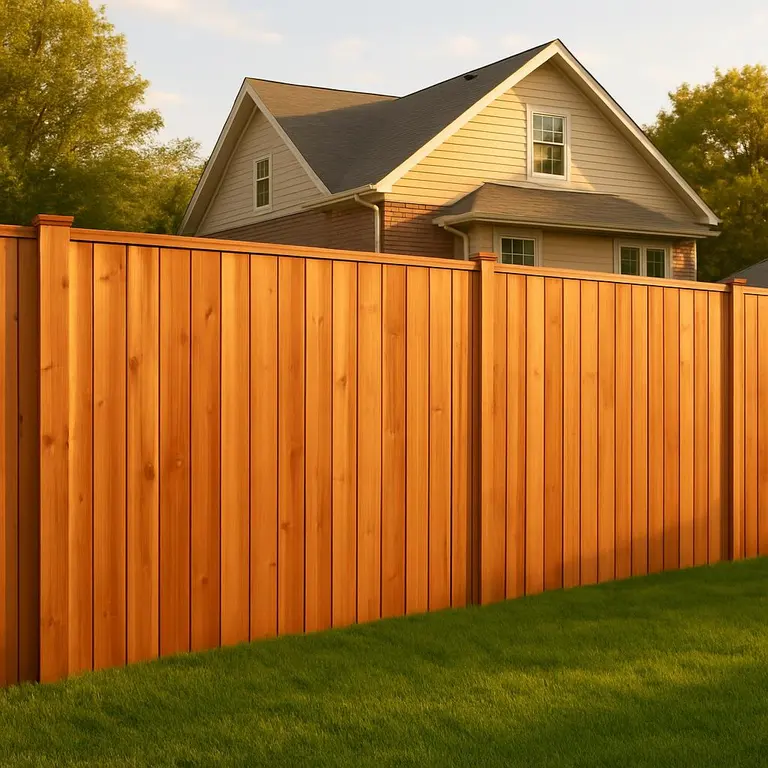
Boards seated edge to edge in routed top and bottom rails, fully opaque and identical from both sides. The closest composite comes to a board-on-board cedar fence, and the configuration most of our composite work is.
Semi-privacy spaced board
The same board set with a deliberate reveal between courses. It passes air and light, softens the wall effect on a small yard, and is often what an HOA will approve where a solid six-foot run will not be.
Horizontal board
Boards run lengthwise between posts for a contemporary line. It reads well against modern architecture, but the spans want closer post spacing because the board carries its own weight between supports rather than being stacked.
Composite picket
Spaced vertical pickets in a front-yard height, giving a traditional picket line that never needs repainting. A common answer where a township caps front-yard height and the homeowner does not want to maintain white paint.
Capped composite
A construction rather than a profile: a bonded polymer shell co-extruded over the composite core. It carries the colour, resists surface staining and fades less than uncapped board, and it is the specification worth paying for.
What to expect
How the Installation Runs
- Site walk and layout. Composite panels seat in routed rails and do not rack, so a sloped line has to be stepped — we set the step layout and the gap at grade under each section on the walk, before any material is ordered.
- PA One Call utility mark-out, filed and cleared before a post hole opens. Composite posts want a wider footing than a cedar line does, which puts the auger closer to whatever is buried out there.
- Permit and HOA architectural submission. Composite colour and profile go through architectural review where a community requires it, and it pays to do that early, because the finish is permanent — a rejected colour is not a repaint, it is a rebuild. Height, setback and the frost line depth all come from your specific township, since Pennsylvania municipalities adopt and amend the Uniform Construction Code independently.
- Post setting. Footings sized to the panel weight rather than to a standard hole, dug below the local frost line, then left to cure before anything is hung on them.
- Panel assembly with the specified expansion gap set to the temperature on the day of installation, so the run stays flat through a July afternoon and does not rattle in January.
- Gate hanging and walk-through — aluminum-framed leaf, hardware sized to the actual weight, and a check of the whole run for plane, plumb and consistent reveal before the crew leaves.
Common questions
Composite Fences Questions
What is composite fencing actually made of?
Wood-plastic composite is wood flour — finely milled wood fibre — blended with polyethylene and additives, then extruded under heat into boards, rails and posts. The wood content gives the board its density, grain texture and the solid sound of a real board, while the polymer encapsulates that fibre so it does not absorb water. Better systems are capped, meaning a bonded polymer shell is co-extruded over the composite core to carry the colour and resist staining. The core is also what gives composite its mass, and that mass is why the posts and footings under it are specified differently from a cedar fence.
Does a composite fence need to be stained or sealed?
No, and it should not be. There is no exposed wood grain for a stain or a sealer to penetrate, so a finish applied to composite sits on the surface as a film and eventually peels off it. Maintenance is washing — a hose, mild soap and a soft brush for pollen, for the mildew shadow that forms on a north face, or for the grit that comes off a driveway. Keep a pressure washer well back, because close-range pressure can raise the surface on uncapped board. That is the entire schedule, and it is the main reason homeowners choose composite over cedar.
Does composite fencing fade?
Some, early, and then it settles. Most composite goes through a modest lightening during its first several months of UV exposure and then holds close to that tone for the rest of its service life. Capped board fades less than uncapped, because the colour lives in a bonded polymer shell rather than in the composite core itself. Compare that with cedar, which does not so much fade as change character: left unfinished it turns silver-grey within a season or two, and holding its original tone means re-staining every few years. Composite trades one small early shift for never touching it again.
Why are gaps left between composite fence boards?
Because composite expands and contracts with temperature along its length, unlike wood, which moves with moisture across its width. Every system specifies an end gap where the board seats in the routed rail, and the correct gap depends on the air temperature the day the panel is assembled — tighter in summer heat, wider on a cold morning. Fit the boards tight in January and the panel will bow out of plane the following July. This is the most common installation error we find on composite fence somebody else built, and it is not correctable without taking the panel apart.
Can composite fence be painted or refinished if it gets damaged?
Realistically, no, and this is the honest limitation of the material. A wood fence that gets gouged, weathers unevenly or simply stops matching the house can be sanded and re-stained. Composite cannot be sanded back, and paint on a capped board has nothing to key into. A light scratch on uncapped board can sometimes be blended with a stiff brush and a season of weathering, but the repair for real damage is replacing the board. Choose the colour on the assumption that it is the colour you keep, and take a sample home before committing to a run.
Is composite worth it compared with cedar or vinyl?
It depends on which problem you are solving. Composite costs more up front than either one, and on a long run that gap is real. What it buys is the removal of the stain cycle cedar needs and the mass, grain and shadow line that vinyl does not have. Choose cedar if you want a natural material and do not mind maintaining it. Choose vinyl if the lowest maintenance for the lowest outlay is the priority. Choose composite when you want a fence that reads as a board fence from the patio and will never be stained. Our written estimate covers all three.
Get a free composite fences estimate
On-site assessment. Written quote. No obligation.