
Fence & gate services
Privacy Fence Installation
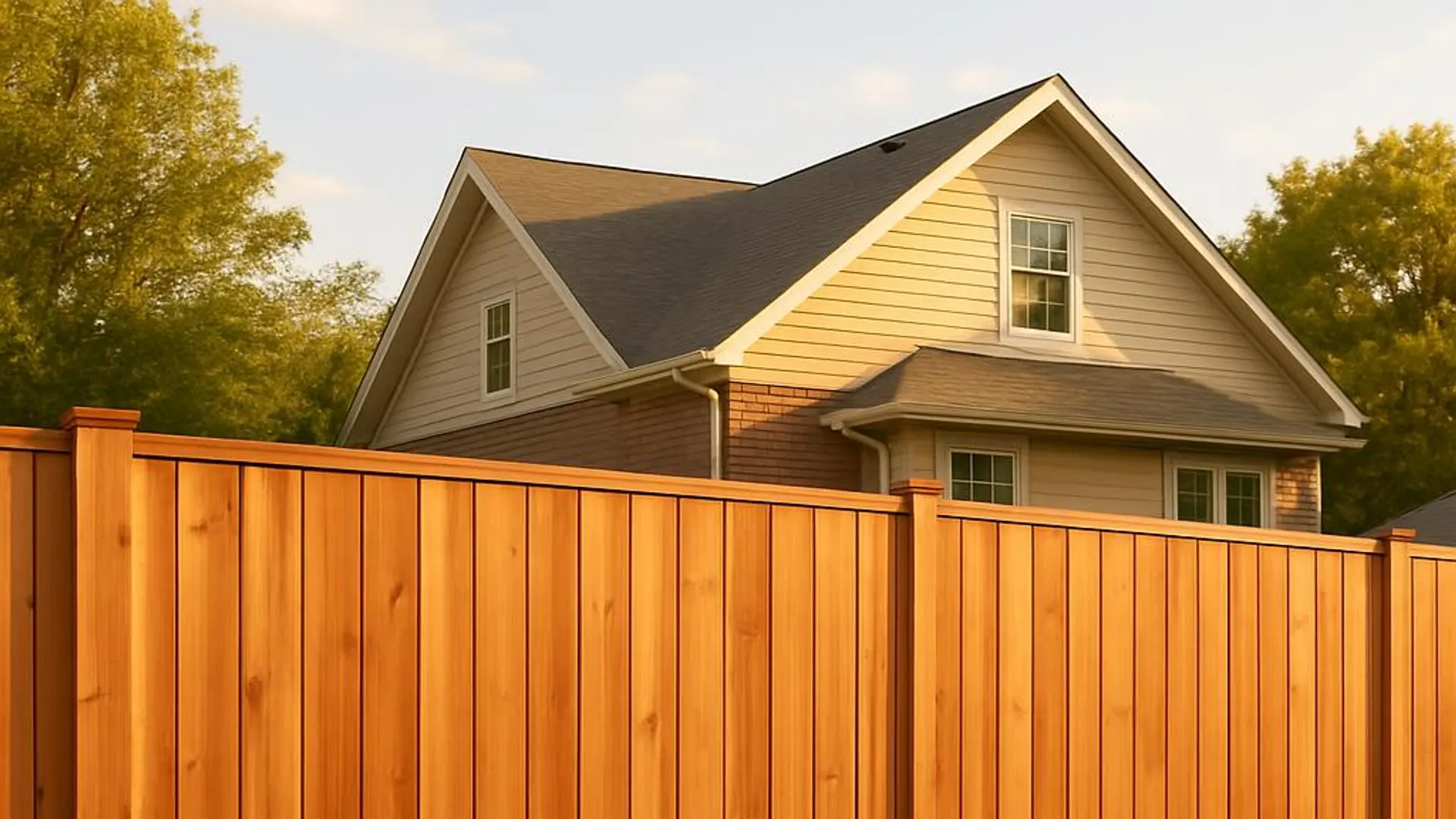
A privacy fence is the one structure on your property that has to be right on all three axes at once — sightline, structure and setback. Get any of them wrong and you either lose the privacy you paid for or you move the fence.
Licensed & Insured
PA Home Improvement Contractor #PA035784
Free Written Estimates
On-site assessment included
Permits & HOA Handled
We file on your behalf
Workmanship Guarantee
On every installation
Privacy Fences in Chester & Delaware County
Privacy fencing is the largest share of what we install across Chester and Delaware County, and the majority of the calls we take start the same way: a rear property line that backs onto a neighbor, a road, or a development that went up after the house did. The job is to close that sightline without turning the yard into a box.
The two materials that do it well here are western red cedar and vinyl. Cedar reads warm and natural, takes stain, and holds its structure for 15–25 years when the posts are set properly. Vinyl is the near-zero-maintenance option — you wash it, and that is the whole maintenance schedule — with a 20–30 year service life. Pressure-treated pine is the budget option and it works, but it moves more with humidity and wants a stain schedule to stay looking intentional.
Height is where most homeowners get surprised. Six feet is the residential standard and what almost every township in our territory permits by right in a rear yard. Eight feet is available in cedar and in some vinyl systems, but it usually triggers a variance, and in an HOA it will almost always trigger an architectural review. Front-yard and corner-lot fences are frequently capped at four feet regardless of material — a rule that catches people on corner properties in West Chester borough and along the Main Line constantly.
Options
Styles & Configurations
Board-on-board
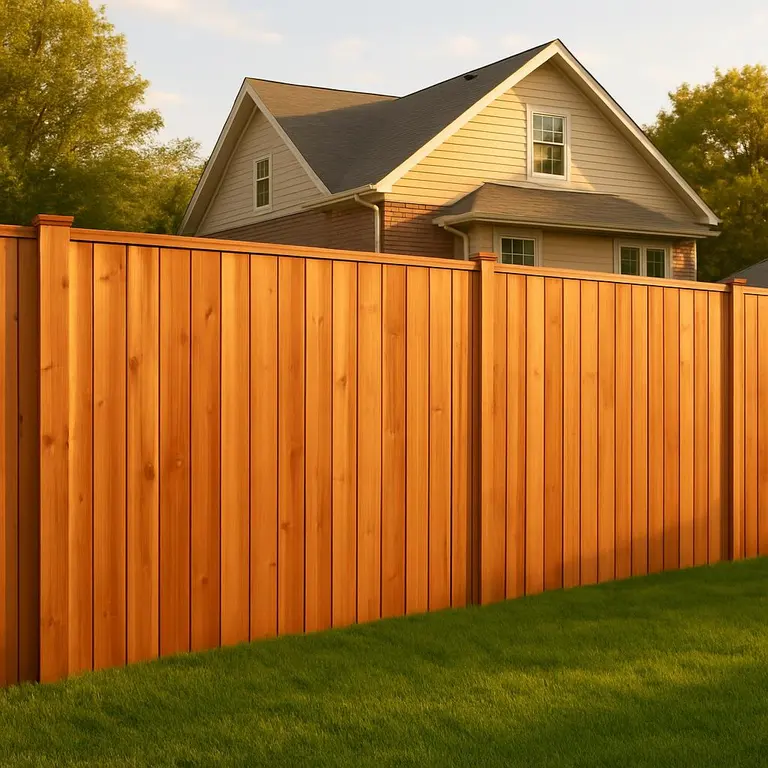
Overlapping vertical boards with no gap at any viewing angle. The most complete privacy and the most material — it looks the same from both sides, which matters when the fence faces a neighbor.
Stockade
Pickets butted edge to edge on a single side of the rail. Economical, full privacy when new, but boards shrink and gaps open as cedar dries.
Shadowbox
Alternating boards on opposite sides of the rail. Nearly full privacy at a straight-on view, air passes through, and it is finished on both sides — the usual answer when an HOA requires a "good neighbor" fence.
Solid vinyl panel
Tongue-and-groove vinyl in a routed rail. Completely opaque, dimensionally stable, and it does not grey, cup or need stain.
Privacy planting
Fence, Screen, or Both
A good share of the privacy calls we take could be answered two ways, and the trade-off is worth knowing before you commit to one. A fence gives you privacy the day the last panel is hung, at a height you pick and keep — six feet stays six feet in December as much as in July. An evergreen screen does not work that way. Arborvitae or holly planted at a size a homeowner will actually pay for takes three to five years to close the gaps between plants, and the first two of those look like a row of shrubs rather than a screen.
What the planting does better is what a fence is worst at. Foliage absorbs road noise where a flat panel largely reflects it. It breaks up a run that would otherwise read as a wall from both sides of the line, which matters on a boundary a neighbor also has to look at, and matters again when an HOA reviews the submission. And it does not carry a service life the way a fence does: cedar is a 15-to-25-year asset from the day it goes up, while a screen that establishes is worth more each year it stands.
On a property line the answer is frequently both, and the two are cheaper and better planned together than fenced first and planted around afterward. The fence goes on the line and does the immediate work — it is also what contains the dog and satisfies a pool barrier while the plants are still small — and the planting goes in front of it, offset far enough that branches are not growing into the boards and holding moisture against them. Three to four feet of clearance for something that matures eight feet wide, and more for spruce. The planting side is the sibling company's work rather than ours.
The other privacy job is smaller and more common than people expect: hiding equipment. Pool pumps and heaters, HVAC condensers, trash and recycling bins, well heads and meter banks. That is usually three panels and a gate rather than a fence line, built in the same cedar or vinyl as the main run so it does not read as an afterthought, with the manufacturer's clearance left around the unit so it is not starved of air and a gate wide enough that a service tech can pull a condenser without taking a panel down.
What to expect
How the Installation Runs
- On-site assessment — we walk the line with you, note grade changes, and identify anything that affects post placement: buried utilities, tree roots, drainage swales, retaining walls.
- PA One Call utility mark-out is filed before any post hole is dug. This is not optional and it is not something to skip on a rush job.
- Permit and HOA submission. We prepare and file the township application and the architectural review packet where one is required.
- Post setting. Holes below the local frost line, concrete footings, posts set plumb and left to cure before any panel work.
- Panel and gate hanging, on a following day, so nothing gets hung on green concrete.
- Walk-through. We check gate swing, latch alignment and the finished line with you before the crew leaves.
Where we install it
Privacy Fences By Town
Common questions
Privacy Fences Questions
How tall can a privacy fence be in Chester County?
Six feet is the residential standard permitted by right in rear and side yards across most Chester and Delaware County townships. Front yards and street-facing corner-lot sides are commonly capped at four feet. Eight-foot fences generally require a variance. Because the limit is set by each township — and separately by your HOA — we confirm both before we quote a height.
What is the difference between board-on-board and shadowbox?
Board-on-board overlaps the boards on the same side of the rail, giving complete privacy from every angle and an identical appearance on both faces. Shadowbox alternates boards on opposite sides of the rail, so it is finished on both sides and lets air through, but a sharp viewing angle will show partial gaps. Shadowbox is the usual choice when an HOA requires a fence that looks the same to the neighbor.
Do I need a permit for a privacy fence?
Most townships in Chester and Delaware County require a zoning or building permit for a fence, and requirements vary by municipality. We prepare and file the application as part of the job, along with any HOA architectural review submission.
How long does a privacy fence installation take?
Most residential privacy fence projects run one to two days of on-site work, split so that posts are set and allowed to cure before panels are hung. Larger properties, heavy grade changes or complex gate systems extend that to two or three days. Permit turnaround is separate and depends on the township.
Should I choose cedar or vinyl for a privacy fence?
Cedar if you want a natural, warm appearance and are willing to stain every three to five years — it reads as the more premium material from the street. Vinyl if you want to do nothing but wash it, and you are comfortable with a uniform white or tan finish. Cedar typically lasts 15–25 years, vinyl 20–30.
Can a privacy fence follow a sloped yard?
Yes, two ways. Racking lets the panel follow the grade continuously, which suits vinyl and pre-built cedar panels on gentle slopes. Stepping holds each section level and drops it at the post, which suits steeper grades and board-on-board. On a walk-through we will tell you which the grade calls for, because racking a slope that is too steep leaves gaps at the bottom rail.
Get a free privacy fences estimate
On-site assessment. Written quote. No obligation.