Fence Guide
HOA Fence Rules on the Main Line
How architectural review actually works in Main Line communities, the restrictions that come up most often, and how to put a submission together that gets approved without a second round.
Last updated
Along the Main Line — Bryn Mawr, Wynnewood, Narberth, Gladwyne, Villanova, Haverford, Wayne and Devon — a substantial share of properties sit in communities with an architectural review requirement, and fencing is one of the things most consistently reviewed.
Architectural review is separate from the municipal permit. It has its own submission, its own committee and its own calendar, and approval from the township tells you nothing about whether the HOA will approve the same fence. Where the two conflict, the more restrictive requirement governs in practice.
The restrictions that come up most often
Main Line HOA standards vary considerably, but a consistent set of restrictions recurs.
- Approved material lists. Many communities permit wood and aluminum but exclude vinyl, or permit vinyl only in specified colours. Chain link is excluded almost universally in front and side yards.
- Colour restrictions. Black is nearly always permitted for aluminum; white vinyl frequently is not. Stain colours on wood may be specified.
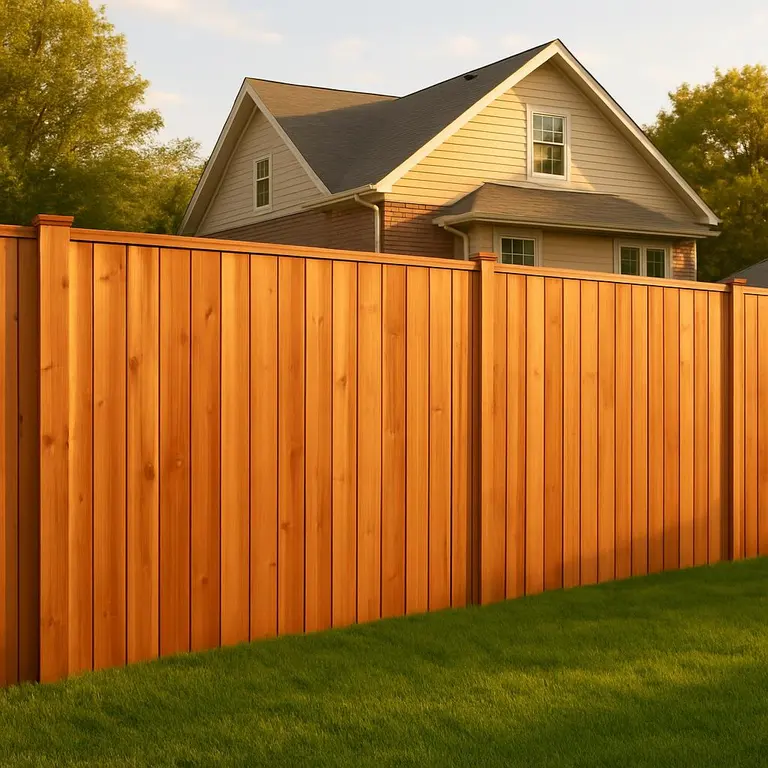
- The "good neighbour" requirement — the fence must look identical from both sides. This rules out standard stockade and one-sided board fence, and is the single most common reason a design has to change. Shadowbox and board-on-board are the usual compliant answers.
- Height limits below what the township permits. A community may cap fencing at four feet where the township would allow six.
- Front and street-facing restrictions. Many communities prohibit fencing forward of the house line entirely, or permit only low decorative fencing there.
- Setback from common areas, sidewalks and community landscaping.
Read the governing documents before you design
The requirements live in the community's declaration of covenants and in the architectural guidelines, which are usually a separate and more detailed document. Both should be available from the management company or the board, and both are worth reading before a design exists rather than after.
Pay particular attention to the definition of what triggers review. In many Main Line communities replacing an existing fence in the same location with the same specification still requires a submission, and a change of material always does.
Note also whether the guidelines specify a maximum time for the committee to respond. Some do, and a submission that has sat past that window is worth following up on formally.
What a submission that gets approved contains
Committees reject submissions far more often for being incomplete than for proposing something objectionable. A packet that answers every question up front avoids the round trip.
- A plot plan or survey with the proposed fence line drawn on it, dimensioned to the property lines.
- The specification: material, height, style, colour or stain, and post cap detail.
- A manufacturer's cut sheet or a clear photograph of the exact style proposed — not a general catalogue page.
- Gate locations, widths and swing direction.
- Photographs of the existing conditions from the street and from the neighbouring properties.
- Where the community requires it, written acknowledgement from adjoining neighbours.
Sequence the two approvals in parallel
The municipal permit and the HOA review run on independent timelines, and committees frequently meet monthly rather than continuously. Submitting them sequentially can add a month or more to a project for no reason.
Submit both at once, with the same drawings and the same specification, and resolve any conflict between them before fabrication. Where the HOA standard is tighter than the township ordinance, build to the HOA standard.
When we install on a Main Line property we prepare both submissions as part of the job, and we build to whichever requirement is more restrictive.
Where the township line runs through the community
Several Main Line towns straddle municipal boundaries — Bryn Mawr sits across the Lower Merion and Haverford township line, Haverford does the same, and Wayne spans Radnor and Tredyffrin across three counties. A community can therefore contain properties governed by two different ordinances.
That matters because the height you may build by right can differ between two houses in the same neighbourhood. Establishing which municipality governs a specific address is the first step, and it is not always inferable from the postal address.
Common questions
Frequently Asked Questions
Does HOA approval replace a township fence permit on the Main Line?
No. They are separate processes with separate submissions and separate timelines, and you generally need both. Where the HOA standard is more restrictive than the municipal ordinance, the HOA standard is what you must build to.
What is a "good neighbour" fence requirement?
A requirement that the fence look identical from both sides, so that the neighbour does not face the structural side. It rules out standard stockade and one-sided board fence. Shadowbox — alternating boards on either side of the rail — and board-on-board are the usual compliant answers, and both are readily approved.
Can my HOA prohibit vinyl fencing?
Yes. Architectural guidelines routinely restrict material, and excluding vinyl entirely or permitting it only in specified colours is common in Main Line communities. The approved material list is in the architectural guidelines rather than the covenants, so it is worth requesting both documents.
How long does HOA architectural review take?
It depends on how often the committee meets — monthly is common, which means a submission can wait several weeks before it is even considered. Some governing documents specify a maximum response period. Submitting in parallel with the township permit rather than after it avoids compounding the delay.
Do I need HOA approval to replace an existing fence?
In most Main Line communities yes, even for a like-for-like replacement, and certainly for any change of material, colour or height. Check what triggers review in your community's architectural guidelines rather than assuming replacement is exempt.