Fence Guide
Deer Fencing in Chester County, Pennsylvania
What it actually takes to exclude deer from a Chester County property, why eight feet is the working height, and why most township ordinances turn a real deer fence into a variance conversation.
Last updated
Deer pressure in Chester County is not a perception problem. The landscape here is exactly what supports a heavy herd — woodlots, hedgerows, creek corridors and open field edge stitched right through residential development — and there is very little hunting pressure on the suburban side of that mosaic. A homeowner in Unionville, Chadds Ford or East Bradford who says the deer eat everything is describing the actual conditions, not exaggerating them.
This is an advisory guide rather than a service page. Deer fencing is a specialised exclusion product, and for most suburban lots here the honest answer is that a true deer fence is either not permitted by right or not the right tool for the problem. What follows is how deer exclusion works, what the real numbers are, and where a conventional fence does and does not help.
How high a deer actually goes
A healthy white-tailed deer can clear eight feet from a standing position, and a running deer has been recorded higher. That is the ceiling of the animal's ability, not its habit. In practice most deer will not attempt a jump above roughly six feet unless they are pressured, and a great many will not try anything above five.
The working figure for a fence built to exclude deer is eight feet, and the reason is not that every deer jumps eight feet. It is that a fence is a permanent installation dealing with a population over years, in which some individuals are hungrier, more habituated or more pressured than the average. A six-foot fence stops the ordinary deer and is defeated by the motivated one, and it only takes one animal getting in and learning that the food is there.
Two things lower the effective height of any barrier. Sloping ground gives a deer an uphill approach and a downhill landing, worth a foot or more on a bank, which is relevant on almost every rolling parcel here. And a deer that has been inside before knows what is on the other side, which is the largest single variable in whether it tries.
Deer judge a jump on the landing, and the good designs exploit that
Deer have poor depth perception at close range and cannot see well directly in front of them at ground level. An animal approaching a barrier is assessing where it will come down, not how tall the barrier is. Every deer fence configuration that beats the height rule works by making the landing unreadable or unavailable.
The double fence is the clearest case. Two fences of ordinary height, five feet being typical, run parallel four to five feet apart. Neither is a barrier on its own. Together they are, because a deer will not commit to a jump when it cannot see a clean place to land, and the inner fence sits precisely where the landing would be. This is the configuration used on orchards and market gardens where an eight-foot structure is unwanted or not permitted, and the outer run can be something ornamental while the inner one is purely functional.
A slanted fence works on the same principle. Built at roughly a forty-five degree lean away from the area being protected, it presents a horizontal depth the animal has to clear on top of a vertical height, and deer are poor at combining a broad jump with a high one. Six feet of fence leaned outward performs like considerably more. The cost is footprint — an angled fence eats several feet of ground along its entire length, which most suburban lots simply do not have to give. The same logic explains why adding visual mass, such as a dense hedge tight against a rail fence, often does more than adding another rail.
Fencing a garden is a different job from fencing a property
This is the distinction that decides most of these projects, and it is usually the one that gets skipped.
A perimeter deer fence around a whole parcel has to be continuous, has to have every gate closed every time, and has to hold along its entire length including where it crosses woods, wet ground and the driveway. Every gap is a door. On a two-acre lot that is a great deal of fence, a great deal of ordinance exposure, and a permanent change to how the property reads from the road. It also does nothing about the deer that are already inside it on the day it closes.
A fenced garden, orchard, vegetable plot or ornamental bed is a far smaller problem. The enclosure is short, it can be eight feet tall without dominating anything, it can be built from black mesh that visually vanishes at twenty feet, and it protects the plants that are actually being eaten. For most households the plants that matter occupy a small fraction of the lot, and fencing that fraction is cheaper, more effective and much less likely to require a variance.
If the goal is to have a garden, fence the garden. Fencing two acres to protect thirty feet of hosta is the expensive way to solve it.
Mesh, poly and how long each one lasts
Deer exclusion fencing is generally built from one of three material families, and the practical difference between them is service life.
Whatever the material, the failure point is the bottom edge. Deer would rather go under a barrier than over it, and mesh not pinned tight to grade gets pushed up and walked beneath. Ground stakes at close intervals, or a length of mesh turned outward on the ground, closes that route.
- Polypropylene mesh — black woven or extruded plastic, sold in roughly seven-and-a-half and eight foot heights. Cheapest, effectively invisible from a distance, easy to run on tree trunks and light posts. Also the shortest lived: ultraviolet degradation and deer pushing at weak points typically give it five to ten years of working life, and it tears rather than dents.
- Metal hexagonal or welded wire mesh — galvanised or black powder-coated steel, often in a heavier gauge in the lower section where the pressure is. Substantially longer lived than poly, far more resistant to being pushed through, and the usual choice for a permanent garden enclosure. Visible up close, near-invisible in black at a distance.
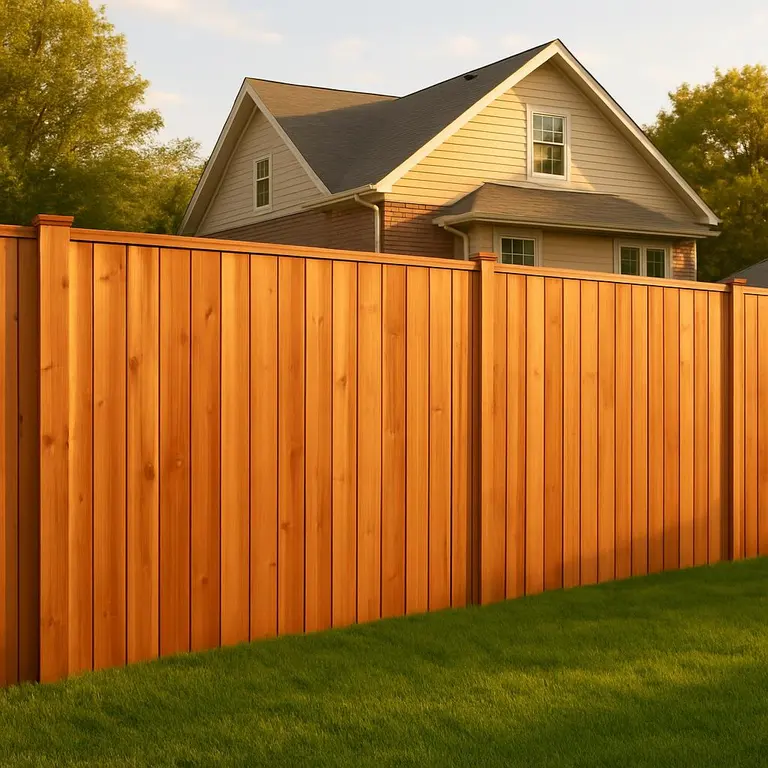
- Rigid fence at height — an eight-foot wood, vinyl or aluminum fence excludes deer by height alone. It is by far the most expensive per foot, the most likely to hit an ordinance limit, and rarely the right answer on a long perimeter. Around a courtyard or a contained rear yard it can be exactly right.
The ordinance problem, and it is the real constraint
Almost every township and borough in Chester County caps residential fence height by right. In a rear yard that figure is commonly six feet, with front yards and the street-facing sides of corner lots frequently limited to four — and corner lots are routinely treated as having two front yards. A fence tall enough to exclude deer is, in most of these municipalities, taller than what is allowed without an application.
That does not make it impossible, it makes it a process. Depending on the municipality the route is a variance from the zoning hearing board, a conditional-use approval, or an agricultural exemption where the parcel qualifies — and Chester County has a great deal of genuinely agricultural ground where that exemption is real. Some ordinances treat garden and crop enclosures differently from boundary fences, and a few exclude open mesh from the height calculation on the grounds that it is not a visual barrier.
None of these figures are uniform, and nobody should treat a number read online as governing. Pennsylvania municipalities adopt and amend their zoning ordinances and building codes on their own schedule, so limits, definitions and exemptions can differ across a township line running through your own neighbourhood. The figures that govern your property come from your township or borough zoning office, and that call is the first step in a deer fence project rather than the last. If the property is in an HOA, architectural review is a second, independent approval on its own timeline, and open-mesh deer fencing is exactly the sort of thing covenants tend to prohibit outright.
What actually works on a suburban lot
For the majority of properties in West Chester, Malvern, Glen Mills and along the Main Line, a full-perimeter eight-foot deer fence is not going to happen. The ordinance will not permit it by right and the lot will not absorb it visually.
The practical strategy is layered rather than absolute, and it starts from the position that reducing pressure is the realistic goal.
- Fence the beds and the vegetable garden instead of the property. A tall, small enclosure in black mesh is the highest-return move available on almost any lot.
- Protect individual specimens. Trunk wrap or a wire cage on young trees stops buck rub in autumn, which does more permanent damage to a young tree than a season of browsing does.
- Use a conventional fence for what it is genuinely good at. A six-foot privacy fence is not a deer fence, but it removes the sightline and the clean approach, and deer route around what they cannot read. A dense hedge on the outside face compounds the effect.
- Change what is planted where it matters. Browse pressure falls heaviest on hosta, arborvitae, yew, tulip and daylily, while boxwood, ornamental grasses, ferns, daffodil and strongly aromatic herbs are largely left alone. At this deer density, planting choice does more work than any fence under eight feet.
- Treat repellents as a rotation rather than a solution. They work while fresh and while the animals are not desperate, and need reapplying after rain.
Where this overlaps with what we build
We are a fence contractor, not a deer exclusion specialist, and the distinction matters when you are deciding where to spend. A dedicated deer fence — eight-foot poly or hex mesh on light posts around an orchard — is a specialised installation, and an outfit that does it every week will do it better than a general fence contractor will.
What we do install overlaps with the deer question in several places. Split rail and post-and-rail fencing is the frontage and paddock fence this county runs on, and mesh backing on the rails is a standard configuration where something needs containing. Wood and vinyl privacy fencing removes the sightline that makes a yard worth browsing through. Aluminum and ornamental fencing defines a perimeter on estate frontage without closing the view. And where a township will permit additional height in a rear yard, we prepare and file the permit application and the HOA architectural submission as part of the job.
If deer are the whole reason you are calling, say so on the first visit. Sometimes the right answer is a fence we build, sometimes it is a much smaller enclosure around whatever the deer are actually eating, and sometimes it is a referral to someone who does exclusion work full time. Estimates are free and written, which makes that an easy conversation to have before anyone commits.
Common questions
Frequently Asked Questions
How high does a deer fence need to be?
Eight feet is the working figure. A healthy white-tailed deer can clear eight feet from a standstill, though most will not attempt more than about six unless pressured. The reason to build to the ceiling rather than the average is that a fence deals with a whole population over years, and it only takes one motivated animal getting in and learning the food is there. Sloping ground lowers the effective height, so an uphill approach argues for more.
Can deer jump a six-foot fence?
Yes, and in Chester County they regularly do where the motivation is strong enough. Six feet stops the average deer and is defeated by a hungry, habituated or pressured one, particularly on ground that slopes toward the fence and gives an uphill takeoff. A deer that has been inside the enclosure before is far more likely to try again, because it knows what is on the other side. Six feet reduces pressure; it does not exclude.
Does a double fence really keep deer out?
It does, and it is one of the more elegant solutions. Two ordinary fences around five feet tall, set four to five feet apart, work because deer judge a jump by where they will land rather than by how tall the barrier is. The inner fence occupies exactly the landing zone, so the animal will not commit. It is the standard approach on orchards and market gardens where an eight-foot structure is unwanted or not permitted by the ordinance.
Do I need a permit for an eight-foot deer fence in Chester County?
Almost certainly some form of approval, because most townships and boroughs here cap residential fence height by right at around six feet in a rear yard and lower in front and on corner lots. Depending on the municipality the route is a zoning variance, a conditional-use approval, or an agricultural exemption where the parcel qualifies. Some ordinances also treat garden enclosures differently or exclude open mesh from the height calculation. The governing figures come from your township or borough zoning office, since PA municipalities amend their ordinances independently.
What is the cheapest effective way to keep deer out of a garden?
Fence the garden rather than the property. A short run of eight-foot black polypropylene or hex mesh on light posts around the beds that are actually being eaten costs a fraction of a perimeter fence, disappears visually at twenty feet, and solves the real problem. Pin the bottom edge tight to grade or turn it outward on the ground, because deer would rather push under a barrier than jump it. Pair it with browse-resistant planting outside the enclosure.
Does JHL Fence install deer fencing?
No. We install wood, vinyl, aluminum, chain link, picket, split rail and post-and-rail fencing, along with gates, pool enclosures and repairs, and deer exclusion mesh is a specialised product outside that list. We are glad to talk through the deer question during an estimate, because several things we do build — privacy fence that removes the sightline, rail fence with mesh backing, added rear-yard height where the township permits it — bear on the problem. Where a dedicated deer fence is the right answer, we will say so.