Fence Guide
Horse Fencing in Chester County
What makes a fence safe for horses — visibility, give and the absence of entrapment — and how the common options compare for paddock, turnout and frontage use in Brandywine horse country.
Last updated
Chester County is genuinely horse country. The ground around Unionville, West Marlborough, Chadds Ford, Mendenhall and out toward the Devon show grounds carries working paddocks, turnout fields and hunt country, and horse fencing here is a distinct specification rather than ranch fence with a different label.
The governing principle is that horse fence is a safety system first. A fence that contains a horse but injures it has failed. Everything below follows from that.
The three properties that make a fence horse-safe
Visibility. A horse will run through a fence it cannot see, and thin wire is effectively invisible at speed. This is why board fence and wide flexible rail work well, and why plain high-tensile wire on its own is a poor choice for turnout.
Give. A horse that hits a rigid fence at speed injures itself on the fence. The safest systems deflect and absorb — flexible polymer rail is engineered to bow and release, board fence breaks, and woven mesh has inherent give. A fence that will not yield at all transfers the entire impact into the animal.
No entrapment. Nothing on a horse fence should be able to catch a hoof or a leg. This rules out barbed wire absolutely, rules out standard field wire with large rectangular openings that a hoof can pass through and twist in, and means hardware should not protrude at leg height.
How the common options compare
- No-climb woven mesh — openings too small to admit a hoof, good give, low maintenance. Usually topped with a board or rail for visibility and to stop horses leaning on it. The safest general-purpose choice.
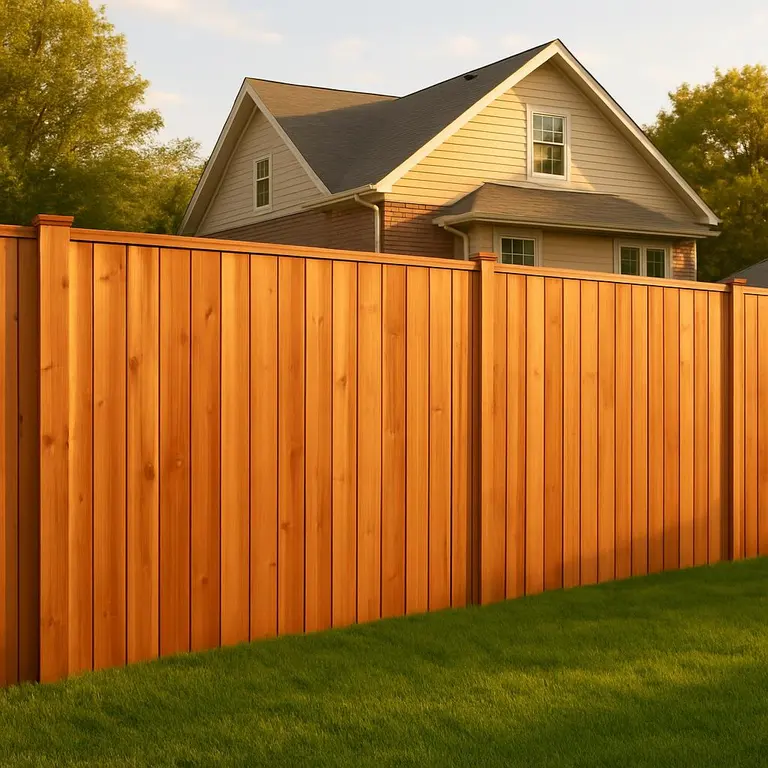
- Board fence (three or four board) — highly visible, traditional, and the county's characteristic look. Breaks under impact, which is safer than not yielding. Higher maintenance: boards need replacing and horses crib on them.
- Flexible vinyl or polymer rail — wide, highly visible, engineered to deflect and release under impact. Low maintenance. More expensive than board.
- Electric top strand — added to any of the above. Not a barrier; a behavioural deterrent that stops leaning, reaching over and cribbing, all of which shorten a fence's life considerably.
- Barbed wire — unsuitable for horses under any circumstances.
- Standard field wire with large rectangular openings — unsuitable for horses; the openings can trap a hoof.
Height, spacing and what the field is for
Specification follows use, and the questions worth answering before anyone quotes are: what animals, what age, is this turnout or a working paddock, and does the field adjoin a road.
A quiet older horse in a large turnout field is a different specification from young stock, and both differ from a stallion. Ponies need tighter spacing near the ground rather than more height. Where a field adjoins a public road the consequence of a horse getting out is severe enough to justify a taller, tighter build than the animals alone would require.
Corners matter more than people expect. A horse pushed into a sharp corner by another horse can be trapped there, and rounding or blocking off tight corners is worth doing at the layout stage.
The build details that determine whether it lasts
Corner and gate posts carry the tension of every run that terminates on them, and on a long paddock run that is substantial. They need to be set deeper, sized larger and braced — an unbraced corner will pull and the whole run goes slack.
Black locust is the traditional post material in this county for good reason: in ground contact it is among the most rot-resistant woods available, and locust posts set generations ago are still standing on properties here. Pressure-treated posts rated for ground contact are the practical modern standard.
Gates should be wide enough for the equipment that maintains the field, not just for a horse. A gate sized only for leading a horse through becomes a problem the first time a tractor needs access.
Common questions
Frequently Asked Questions
What is the safest fence for horses?
Woven no-climb mesh with openings too small to admit a hoof, topped with a board or rail for visibility, is the safest general-purpose specification. It cannot trap a leg, it has give, and the top board keeps the fence visible and stops horses leaning on the mesh. Flexible polymer rail is the other strong option.
Can I use barbed wire for horse fencing?
No. Barbed wire does not yield, and a horse that runs into it or gets a leg over it sustains serious lacerations. It is unsuitable for horses under any circumstances, and the same reasoning excludes standard field wire with large openings that can trap a hoof.
How tall should horse fencing be?
It depends on the animals and the setting. General turnout commonly runs in the region of four and a half to five feet, higher for stallions or where the field adjoins a road. Ponies need tighter spacing near the ground more than they need height. The right answer comes from what the field holds and what is on the other side of it.
Is board fence or mesh better for a paddock?
Mesh is safer and lower maintenance; board is more visible and more traditional. The common answer is both — no-climb mesh with a top board, which gives the safety of mesh and the visibility of board. Board alone suits larger fields with quiet stock; mesh matters most with foals or where a leg could otherwise go through.
Do I need an electric strand on horse fencing?
Not for containment, but it earns its place. Horses lean on fences, reach over for grass and crib on wooden rails, and all three shorten a fence's life considerably. A single electric top strand stops the behaviour without being the thing that holds the horse.
What are the best fence posts for a paddock?
Black locust in ground contact is the traditional and highly rot-resistant choice in Chester County. Pressure-treated posts rated for ground contact are the practical modern standard. Corner and gate posts should be larger, set deeper and braced, because they carry the tension of every run terminating on them.