Fence Guide
Pool Fence Requirements in Pennsylvania
What the adopted building code requires of a residential pool barrier in Pennsylvania — height, gaps, picket spacing, climbable members and gate hardware — and how to make sure yours passes inspection the first time.
Last updated
A pool barrier is the one fence on a Pennsylvania property with a code section written specifically about it, and it is inspected. Most of the failed inspections we see are not close calls — they are fences that were built as ordinary privacy or picket fence and then asked to serve as a pool barrier, which is a different specification.
Pennsylvania regulates residential construction through the Uniform Construction Code, which adopts the International Residential Code and its pool barrier provisions. Critically, individual municipalities adopt, enforce and sometimes amend that code on their own schedule, so the edition in force in your township may not be the edition in force in the next one. Everything below describes what the adopted code generally requires. The figures that apply to your property come from your municipality, and confirming them before ordering material is the single most useful thing you can do.
The six things a pool barrier has to get right
Pool barrier provisions are not a single rule but a set of them, and a barrier has to satisfy all of them simultaneously. A fence can be tall enough and still fail on gate hardware; it can have correct hardware and still fail because its rails are on the wrong side.
- Barrier height — measured on the side facing away from the pool. The grade next to the fence is part of this measurement, so a berm, retaining wall or raised bed against the outside of the fence reduces its effective height.
- Gap at the bottom — the maximum clearance between the barrier and the finished grade beneath it. On uneven ground this is measured at the worst point, not the average.
- Picket or opening spacing — narrow enough to reject the gauge the code specifies. This is why standard ranch rail and wide-picket fence cannot serve as a pool barrier.
- No climbable horizontal members on the outside face within the barrier height. This is the requirement that most often catches an otherwise-adequate fence.
- Gates must be self-closing and self-latching, opening away from the pool, with the latch positioned at the required height — or, where the latch is lower, on the pool side with the surrounding area shielded so it cannot be reached through the barrier.
- Where a wall of the house forms part of the barrier, doors and windows giving direct access to the pool carry their own alarm or self-closing requirements.
The climbable-member rule, and why it fails so many fences
This is the requirement homeowners are most often unaware of, and it is the reason an existing fence frequently cannot be reused as a pool barrier without modification.
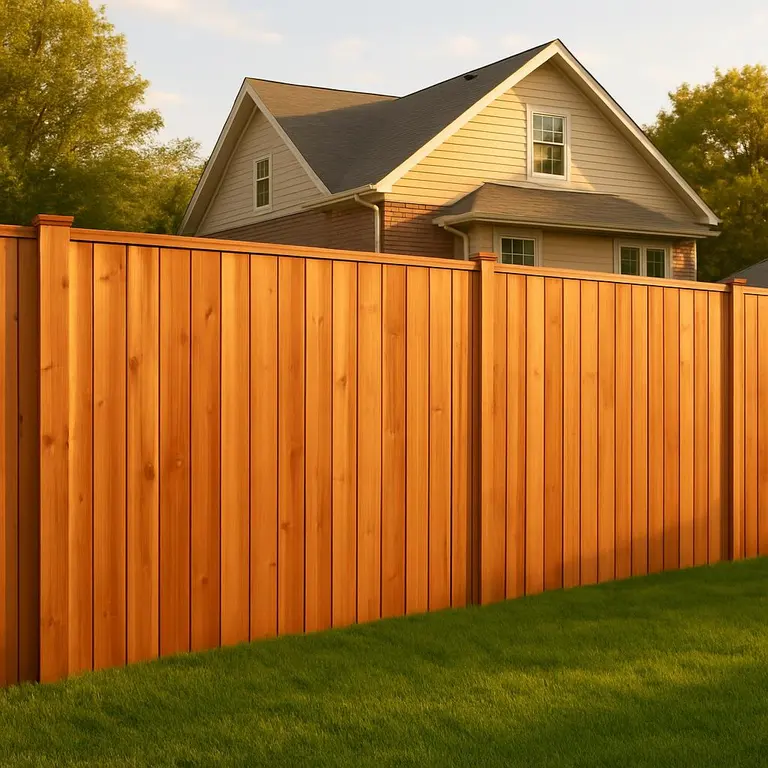
A conventional wood privacy or picket fence is built with horizontal rails, and those rails are usually fastened to the outside face of the posts with the boards on the inside — or the reverse. If the horizontal rails end up on the outside of the barrier within the required height, they form a foothold. A child can climb them. The code treats that as defeating the barrier regardless of how tall the fence is.
There are two fixes. Reorient the fence so that the rails face the pool side, which means the finished face points inward — often unacceptable if the fence also serves as the neighbour-facing boundary. Or use a system with no external horizontals in the first place, which is why flat-top powder-coated aluminum has become the default pool barrier in this region. Its rails sit within the picket line, the pickets are manufactured at code spacing, and there is nothing on the outside face to climb.
Gate hardware is a barrier component, not an accessory
Gates account for a large share of failed pool barrier inspections, and almost always for one of three reasons.
The gate latches but does not self-close. A spring hinge that has been adjusted until it no longer pulls the gate shut, or a gate that binds on the ground at one point in its swing, will fail. The gate has to close and latch from any open position without anyone touching it.
The latch is at the wrong height or on the wrong side. The code sets a latch height precisely so that it is out of a small child's reach. Where site conditions require a lower latch, it must be mounted on the pool side, and the barrier around it must be solid or close-meshed so a hand cannot reach through to operate it.
The gate swings the wrong way. Pool barrier gates open outward, away from the pool, so that the gate closes against its own stop rather than being pushed open by someone leaning on it.
Above-ground pools and pool covers
Above-ground pools are treated differently in an important respect: the pool wall itself can form part of the barrier where it is high enough, in which case the requirement shifts to securing the ladder or steps — typically a removable, lockable or self-closing and self-latching access.
Powered safety covers meeting the applicable standard can substitute for some barrier requirements in certain circumstances. Whether that applies to your installation is a municipal determination, not a general one, and it is worth asking directly rather than assuming.
What to do before you order a fence
Call your township or borough code office and ask three questions: which edition of the code they enforce, what barrier height they require, and whether they have any local amendment to the pool barrier provisions. Municipalities answer this readily, and the answer determines the material order.
If you are in an HOA, run the design through architectural review at the same time. A barrier that satisfies the code and violates the community standard is still a problem, and the two reviews run on independent timelines.
When we install a pool enclosure we confirm the requirement with the governing municipality before ordering material, file the permit, and walk the completed barrier against the requirement — height, gaps, spacing, latch height and gate swing — before the inspector arrives.
Common questions
Frequently Asked Questions
How tall does a pool fence have to be in Pennsylvania?
Pennsylvania enforces pool barrier height through the adopted building code at the municipal level, and the required height is measured from the finished grade on the side facing away from the pool. Because municipalities adopt and sometimes amend the code independently, the figure that governs your property comes from your township or borough code office. Confirming it before ordering material avoids a barrier that has to be rebuilt.
Can I use my existing privacy fence as a pool barrier?
Sometimes, but not automatically. A privacy fence can satisfy the height and gap requirements while still failing on climbable members — if its horizontal rails are on the outside face within the barrier height they form a foothold. Gate hardware and the gap at grade also have to be addressed. It is worth having the existing fence assessed against the barrier requirement before assuming it can be reused.
Does a pool gate have to be self-closing and self-latching?
Yes. A pool barrier gate must close and latch by itself from any open position, without anyone touching it, and must open away from the pool. The latch must be at the height the code specifies, or mounted on the pool side with the surrounding barrier shielded so it cannot be reached through.
Why is aluminum the standard choice for pool fencing?
Because it satisfies the barrier requirements cleanly. Flat-top powder-coated aluminum has no protruding finials, its rails sit inside the picket line so there is nothing climbable on the outside face, picket spacing is manufactured to code, and self-closing self-latching hardware is a standard option. It also does not rust in a wet, chlorinated environment.
Do I need a permit for a pool fence in Pennsylvania?
Yes. Pool barriers are permitted and inspected in every municipality in Chester and Delaware County. The permit is separate from the pool permit itself in most townships.
Does a pool cover replace the need for a fence?
In some circumstances a powered safety cover meeting the applicable standard can substitute for certain barrier requirements, but this is a determination your municipality makes rather than a general rule. Ask the code office directly before relying on it.