Fence Guide
Wood vs Vinyl Fence
An honest comparison of wood and vinyl fencing in a freeze-thaw climate — appearance, lifespan, maintenance, repairability, cost over time, and where each one genuinely wins.
Last updated
This is the decision most homeowners in our territory are actually making, and both materials are defensible. The right answer depends on how you weigh appearance against maintenance, and on how long you intend to own the fence.
What follows is a straight comparison rather than a pitch for either. We install both.
Appearance
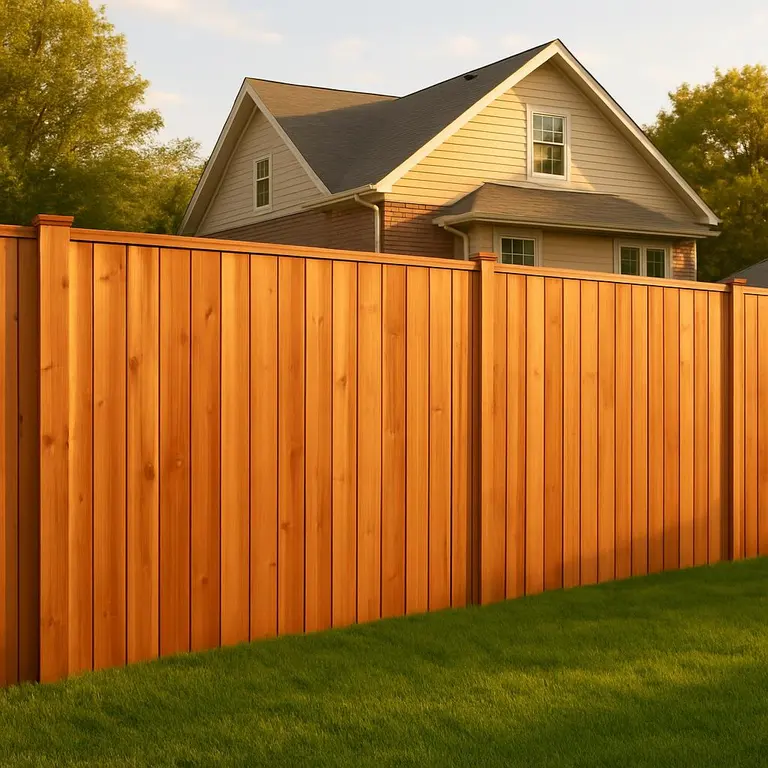
Wood wins on character and loses on uniformity. Cedar in particular reads as a premium natural material, takes stain in any colour, and suits historic and traditional properties in a way vinyl does not. It also shows its variation — boards differ in grain and tone, and the fence weathers.
Vinyl wins on uniformity and consistency. Every panel matches, the colour does not change, and the fence looks the same in year twelve as in year one. Some people read that as clean; others read it as plastic. Textured woodgrain finishes have narrowed the gap but not closed it.
On a historic borough property or an estate frontage, wood is usually the right call. In a development where uniformity is the aesthetic, vinyl often is.
Lifespan and failure mode
Cedar typically runs 15–25 years, pressure-treated pine 10–20, quality vinyl 20–30 or more. But the more useful comparison is how each fails.
Wood fails gradually and visibly. Boards cup, grey and split; the bottom rail rots first where it sits closest to the ground; posts fail at grade. You can see it coming, and you can address it section by section.
Vinyl fails suddenly and locally. It does not rot or grey, but a hard impact — a branch, a mower, a vehicle — cracks a panel outright, and low-grade vinyl becomes brittle in cold and cracks more easily. The failure is a discrete broken piece rather than gradual decline.
Both are repairable. Wood is repaired board by board with material available anywhere. Vinyl is repaired by replacing a panel or a board in a routed rail, which is clean and fast — provided the profile and colour are still manufactured. On a discontinued colour, matching is the real limitation.
Maintenance, honestly
Vinyl's maintenance claim is genuine. Washing it occasionally is the whole schedule. There is no staining, sealing, painting or rot treatment across its life.
Wood's maintenance requirement is also genuine, and it is the thing people most often underestimate. Cedar left unfinished will weather to silver-grey and still perform structurally — that is a legitimate choice, not neglect. But if you want it to stay warm-toned, that is a semi-transparent stain every three to five years on a fence that may run hundreds of feet. Pressure-treated pine needs it more consistently to prevent cupping.
The question is not whether you mind maintenance in the abstract. It is whether you will actually do it in year four.
Cold-climate performance
This is where material grade matters more than material type. Quality co-extruded vinyl with impact modifiers formulated for freeze-thaw climates performs well through Pennsylvania winters. Thin-wall vinyl from a big-box supplier loses impact resistance as temperature drops and cracks — this is the single biggest reason to avoid cheap vinyl panels here.
Wood handles cold without difficulty but moves with humidity, and that movement is what opens gaps in a stockade fence and cups boards on pressure-treated pine. Cedar moves less, which is a substantial part of what its price buys.
For both materials, the actual winter failure point is usually below grade: posts set above the frost line heave regardless of what is above them.
Where each one clearly wins
- Choose wood if: the property is historic or traditional, you want a specific stain colour, you need a custom profile no panel system makes, the fence must match existing woodwork, or budget is the deciding factor and pressure-treated is the answer.
- Choose vinyl if: you want zero maintenance and mean it, you want a uniform finished appearance, the fence is in a development where that is the norm, or you are optimising cost over twenty-plus years rather than at installation.
- Choose neither if: the fence is a pool barrier where flat-top aluminum is the cleaner code answer, or the run is frontage on a large parcel where post-and-rail or ornamental is what the property calls for.
Common questions
Frequently Asked Questions
Does vinyl fence last longer than wood?
Generally yes. Quality vinyl runs 20–30 years or more; cedar 15–25; pressure-treated pine 10–20. The caveat is material grade — thin-wall vinyl can fail faster than good cedar, because it becomes brittle in cold and cracks.
Is vinyl fencing more expensive than wood?
Usually more than pressure-treated pine and comparable to or slightly above cedar at installation. Over the life of the fence vinyl typically costs less, because there is no staining, sealing or board replacement.
Can vinyl fence be repaired?
Yes, and cleanly — vinyl is a panel-and-post system, so a damaged section or an individual board in a routed rail can be replaced without disturbing the rest of the run. The limitation is matching a discontinued colour or profile on an older fence.
Does wood fence require staining?
Not structurally. Cedar is naturally rot resistant and performs unfinished, weathering to silver-grey. Staining is about holding the warm colour and adding years at the margin. Pressure-treated pine benefits more from a consistent stain schedule, which prevents cupping.
Which is better in a cold climate, wood or vinyl?
Both perform well if specified properly. Quality co-extruded vinyl with impact modifiers handles freeze-thaw without trouble; cheap thin-wall vinyl becomes brittle and cracks. Wood handles cold fine but moves with humidity. For either, the real cold-weather failure point is post footings set above the frost line.